Sunday, December 6, 2009

Framing

Kolkata, India and San Francisco/Oakland/Berkeley, USA

This blog was intended to be a holding place for a collection of writings about two years spent living and working in Hyderabad and Kolkata (and Delhi and…), India. It skips over most of the daily details, although some overview of those can be found in these types of posts – the pieces I posted here allowed me to hang some glittering words around an assortment of experiences that stretched my mind in every possible direction. As I tried to sum up my ‘learnings’ for a closing presentation to a community that raised me, these are the bullet points I came up with (and the details? those are in the blog posts):
• The mutability of language and the vagaries of communication
• Patience: total capacity vs. current reserve
• Resources and the impact of American consumption
• Comfort as a choice
• Experiencing otherness
Both years were spent with the same NGO, and with support from AJWS, but everything from the type of work to the type of office, from my room-mates to my dance classes, from the cuisine to the root of the language was radically different, in wonderful ways. I don’t have a review article for the whole experience, but below is a volunteer report, a short piece I was asked to write up by the office I worked with in Kolkata. Considering that I left from Kolkata, I think it’s an appropriate place to leave this archive – for now.

Volunteer Report for Sep 2008 – May 2009

I first met members of the NGO’s Kolkata office at the all-office Program Management Retreat, which was held at a small beach-side resort south of Chennai, Tamil Nadu in December 2007 – and I felt an instant companionship. There was something excitable, something subtly deviant, about the group that caught my attention, and from the World AIDS Day shirt to the gender-bending I knew that these were people I should get to know. As we discussed the inter-related but often competitive strategies of empowering women versus breaking down the idea of gender entirely in between sessions on grant writing and program management, my first impressions were confirmed: the Kolkata office had a lot to teach me.

Effective social change work requires a dynamic and inclusive ideas of community, and that is exactly what I found when I arrived in Kolkata, a city dedicated to the goddess in all her forms, and exported as the poverty-ridden once-shining center of the painstakingly dismantled British Raj. I came looking for intellectuals, artists, communists, queers – and found all that and more, in abundance (if there is anything that India does not lack, it is abundance). As I started moving around Kolkata, meeting different circles of people, both through work and through friends, I was amazed at the strength of the influence that the office, and especially it’s director, have had on the queer and AIDS activist communities – everyone linked in to those circles knew of the director and the office’s work, and felt that it had been influential in encouraging them to pursue their interests and to seek answers to difficult questions.

My main work in the Kolkata office was technically based outside of it – helping to organize and expand the NGO’s national and regional advocacy work with a focus on women’s empowerment and access to resources – but this work fused naturally with learning about and assisting with the office’s emerging advocacy projects, as well as the community events and resources that it has become known for in Kolkata, from the Pride march to the film festival to the resource library. I got to know other projects within the office as I helped individuals with project planning and document preparation, and was lucky enough to visit a major partner in Orissa while assisting them with grant writing. Although I traveled frequently, especially during the second half of the year, Kolkata remained my home.

One of the highlights of my year was the Jewish festival of lights, Chanukah; with another volunteer, I was able to host a gathering for the office in my home, and after many months of learning about Bengali culture, food, and traditions, had the opportunity to share some of the traditions that I had grown up with (not to mention fried potatoes, which seem to be a fairly universal dish). From sharing lunches to late-night abstract editing to celebrating holidays, marches, and successful events together, my time in the Kolkata office was both a precious opportunity to learn and to give, and great reminder of the power of community in the face of adversity.

Monday, July 20, 2009

The Book List, Part III

December 2008 – May 2009

Recreational:

Another Roadside Attraction, Tom Robbins
Tom Robbins is my favorite source of absurdity in a country – not to mention a world – that has a sometimes surprisingly deep and abiding love for boxes. I was skeptical when I was given this book as an apology, and I waited a long time to read it – until the American thanksgiving crossed over the end of the Mumbai terrorist attacks. It became my first auto-rickshaw reading, balanced on the edge of the bench next to the driver and immediately behind the exhaust pipe of a bus, against the edge of a bag pressed against my chest – which is, in a sense, exactly where Robbins belongs. This was not my favorite of his, but it was magical and familiar and twisted and enlightened, and that was enough.

A Backward Place, Ruth Prawer Jhabvala
It is stunning, and humbling, and in the end not at all surprising, how little the expat experience, let alone ‘scene,’ has changed in India over the last fifty years – an insightful sliver of individual ambitions and reformed identities in a world where everyone seems to be living out of context.

Siddhartha, by Herman Hesse
A classic, which I have very little right to review here. I found it contained a lot of wisdom, many forms of which had passed through my mind at various points, but rarely with Hesse’s elegant poise.

The Shadow Lines, Amitav Ghosh
This made an excellent commuting book, as large sections of it took place in and around Gol Park, which I passed every day on the way to and from work. Although it is not considered one of Ghosh’s best books, it provides a quietly powerful analysis of fantasy and of lives built between worlds.

The Age of Kali, William Dalrymple
Somewhere between feeling guilty of being an escapist reader and wanting to both judge and improve my own writing about India, I decided it was imperative that I read this book. Written as Dalrymple was converting from a travel writer to a historian, these brief and brightly colored essays on travels through India are at turns disgusted, amorous, and incredulous – but my favorite thing about them is that they lay out contrasts, and rather than spelling out the difference, allow you to make your own judgments about the serious spectacle of life in and around the country.

The Argumentative Indian, Amartya Sen (second half)
As carefully written, and as equally dry and brilliant, as the first half – very academic, but definitively worth reading.

The White Tiger, Aravind Adiga
The winner of the 2008 Booker prize, I read a very Indian counterfeit copy of this book (probably wrapped in cellophane and sold by a boy at a traffic light or an illiterate man in stack of books on the sidewalk – but I borrowed it from a friend, so I wouldn’t know the details), and enjoyed the rush of the story and the knowing details. I’m far from convinced of its enduring brilliance, but I do think that it provides a valuable portrait of one more mustachioed entrepreneur.

Theoretical:

Same-Sex Love in India, Ruth Vanita and Saleem Kidwai
This revered book presents a thorough review of the depiction of various forms of same-sex love in Indian writing from ancient to modern times, accompanied by detailed and insightful essays on the patterns, pressures, and paradigms that the authors have identified in the texts.

Sexuality, Gender and Rights: Exploring Theory and Practice in South and Southeast Asia, edited by Geetanjali Misra and Radhika Chandiramani
The title says it all.

Current:

Temptations of the West: How to be Modern in India, Pakistan, Tibet and Beyond, Pankaj Mishra
The introductory essay is tantalizing, and although the main sections of the book seem to be less personal (I got about halfway through the Gandhi-Nehru dynasty, for the umpteenth but still relevant time), Mishra seems to be an author to keep an eye out for.

Gravity’s Rainbow, Thomas Pynchon
Around page 130, I realized that this book was about (among other, both larger and smaller, things) World War II, and was ready to start reading it. I’ll report back in another seven hundred pages.

Wednesday, June 17, 2009

Aila

May 25, 2009
A slum in Howrah, and an upscale neighborhood in south Kolkata, West Bengal

I was holding her and the world was revving up, bare bottom against impending rain, tiny legs and withered feet nearby, upset trees pushing walls and pulling concrete sidewalks, fast enough to pass easily to the other side, bright orange sindoor streaked through oiled black hair and false pairings so that at nineteen or maybe at sixteen with some years tacked on she looked like a painting of the immaculate conception – because some days you don’t want to think about the other way – soft cloth draped around wide eyes and quietly pursed lips, a smooth forehead given over to lack of choice catching the pot before it boils over and bending easily so that wading through plastic bags locked through sandal straps and half-submerged dogs seem like small annoyances, a privileged taste of daily discomfort to chastise human adaptability.

We talked about automatic car washes the sound of rotating whipping strands hitting heavy glass with a soapy thud in monstrous rollers slapping up and down and around the perfectly sealed bubble so that even the slightest leak would cause a gasp of surprise but the whittled bits of water flying sideways through the mostly-rolled up windows and gathering on the rotting rubber door seals caused only enough worry to move the electronics to a different lap while the wheels bumped up the curb and carried us down the sidewalk, around the improvised road black through patches of eye-induced sunshine bright enough to illuminate the slowly changing scenery of endless traffic jams, buses stuck near the top of horizontal trees and small white sedans pulling back branches to slap the next kid in line with a wet green surprise.

Under an easy stream of hot water, through yellowed glass and maybe a metal grate or over a low concrete wall, I could see the palms bending backwards over the railway tracks, silently swirling wide skirts, just on time for their date with the nearest edges of the city – it was a flying ceramic roof tile that had sent us scampering in the first place, umbrellas bending into angry upside-down spiders and black tarps snapping against twine leashes as we scurried between doorways and submerged drains, down six-inch alleyways, towards infrastructure less prone to unintentional scattering so that now, roof tiles three floors above me and walls thick enough to block electric signals, windows double-barred, beds made with space to spare, where generations are three decades apart and babies given five times their weight in antibacterial plastic playthings, the storm seemed safely tucked away in bed long before I set out through freshly swept streets in search of dinner.

At the end of the story – weeks later, ensconced in heat rashes and air conditioning – the communists drove up, white hammers crossing nicely curved sickles on red flags flapping a low flat-bed truck draped in donated clothes forward, an old man seated like a sometime king in the center, looking nonplussed and oddly out of place as younger men scurried to doors and stores with canisters and requests for change – anything to help the victims, baby food for the little ones in the sunderbands, stacks of mismatched scarves flowing over strong city worker arms so I scurried off down the street, calling for the bill, bag of bulging chiffon and cotton on the way back, momentarily not minding the sweat pouring easily through every pore in a single-minded mini-quest to feel less guilty about the piles I was leaving, to align some abstract goal with the current exit plan in the hope of being a responsible guest ready to slip out the side door through one more massive city-side traffic jam, one more dinner, two more lunches plus a handful of airport meals, through re-immersion movies and back to the far side of the storm.

[This was written on June 14, a day and a half before leaving Kolkata, and posted from the US]

Wednesday, June 3, 2009

The Great American-Bengali Passover Seder

April 8-16, 2009
A Journey

1: At large
I had only eaten rice-based foods that day – idly for breakfast, and an extensive south Indian thali (rice, rice, dal, vegetables, and curd rice) for lunch – so I decided to put off Passover by one sundown in order to mark it better. My last supper was kebabs, parathas, and curries served aboard an imaginary train on the top floor of a freakishly slick Hyderabadi mall.

This was my second Passover in the City of the Nizams, and it passed as easily as the year before – the restriction on eating leavened bread hardly noticeable save a few moments in airports, where I had to walk a few steps past the coffee shop to find a masala dosa for breakfast.

2: In miniature
I arrived in Chennai on what was officially the second night of the holiday, and celebrated on what was unofficially my second night of observation.

Two of my co-workers insisted, almost, on helping me, sharing something. I heard myself warning them, repeatedly, of the length of even a shortened version of the Passover seder, saw the three of us, home-brewed wine drops spilled to the count of ten and the sweet and the bitter combined, sleepily searching for dinner in the last canteen left open. But the re-telling – that I did first, coherently for a deconstructed fable of imagining a homeland, followed by an incantation to equality in freedom.

3: Just right
I landed in a headlong rush home, slouching in the back bench of the flaking yellow taxi, calling and texting, arranging food contributions and personal absences. Once inside, I gleefully flung off the rubble I’d collected through the past two weeks of travel, throwing sweaty salwars, a slightly mildewed toothbrush, emptied bottles of shampoo and lotion off to their respective corners, flipping switches and re-arranging until I had completely arrived. It is important, when preparing to celebrate a holiday about exile from slavery towards freedom, when in the fourth quarter of a life built in a foreign land, and just returning from an excursion to sites marked with first footsteps and bloodied knees and dance floor histrionics, to have arrived before getting ready to leave again.

I gathered the recipe and washed the lentils and turned on the stove. I begged the gardener to find me a new can of gas, and waited on the doorstep for as long as it took me to realize it would not be long enough. I rinsed off the remaining airport grime, and, large metal pots bulging from a creaking woven bag, threw my arrival to the dirty, humid Kolkata wind, and caught an auto-rickshaw to a friend’s house.

We cooked, and listened to good bad music (this is required for long spells of cooking), and vaguely discussed what we were going to do with fifteen people who had no idea what was going on. The fifteen people – five less than we had guessed, but just the right number to fit in a circle of chairs and bed and floor, mostly Christian, Hindu, and various identifies between there and determinedly atheist – arrived, with wine, and sweets, and quiet chatter. We followed an order – which is, after all, what seder means – and interrupted it consistently with our own deviations.

There were four Jews, and thus four opinions – but we agreed on ‘Go-down Moses,’ and although we started on the far side of off-key, and the rising chorus lit up the evening. By the time the meal had finished, the room was half asleep, and the weight of travel, the release of the determined burst of energy that had taken me through the holiday caught me up and carried me home. The next day was the Bengali New Year, and I spent the day inside, cradling my queen-size two-inch foam mattress and meditating on the dirty but elegant lace curtains that separated my known and daily re-created world from the adventures on the other side.

Tuesday, May 5, 2009

Five Photos, Take Two

March 30th - April 14th, 2009
Hyderabad, Andhra Pradesh and Chennai, Tamil Nadu

In February 2008, I spent a week working from the Chennai office of my NGO, and wrote about the trip in the form of five ‘photographs’ – below are five moments captured in the same spirit, from a trip I took to work in the southern offices of the same NGO during April 2009.

1. Home, again.
‘My girlfriend says that I can be a chauvinist pig sometimes.’ This was the first thing I heard about Deepthi. A year and a half later, after a plane flight and a twelve-hour work day, I stumbled in to the home she was building with her new fiancé. The basic structure is classic upper middle class Indian – smooth plaster walls, stone floor, high ceilings, windows leading to balconies, built-in bedroom cabinets, a two-burner gas stove and industrial sized bottles of filtered water in the kitchen. Wicker furniture – holding books, ashtrays, wine bottles filled with filtered water – was spread around the room, accented with beds-as-couches and bright, thickly woven cotton drapes. The place felt like a canvas, one that had been stretched and prepped, where the sketches had been drawn but the colors were just being added.

2. Excess
I was giddy all the way home from work, lifted automatically to my toes as I poured a bucket of cool water over my head, giggled and fidgeted my way in to make-up and tight black clothes with a friend. I ignored the empty expanses we passed on the way to the club, and tried to let the grotesque concrete skeletons of half-completed office parks and walled apartment complexes flick quickly by on the edge of my vision. Excess, the momentary hotspot of the mercurial and yet numbingly consistent Hyderabadi nightlife, was inside a hotel that I’d heard about from wealthy friends who used to brunch there, swim there – past the edge of the city, where even a hint of metropolitan poverty, of congestion or the unmet needs of millions, could not disturb the full first-world fantasy. The club itself came in two layers, with stylized dens for lounging, and a porch from which to view the miles of surrounding construction while leaning on glass tables with white podiums lit from below.

3. Planes
I’ve always felt at home on an airplane, suspended in between, scanned for intentions, packaged for delivery – I pick up when I walk through the door, tugging or shouldering my pile of clothes a little closer, standing up, stepping briskly ahead. I enjoy flying in India for the air-conditioned luxury it affords, and for the higher standards of customer service, in that sickeningly entitled American sense of expecting to be seen as an individual and valuable consumer. I read somewhere that the Indian skies are filled with more private than commercial jets – I’m not sure if that is still true, but the culture of the skies is both elite and quickly changing. The air hostess on my first flight to India wore a saree; every air hostess I’ve encountered since has worn a tight, short skirt or hip-hugging pants, with matching eye shadow and lipstick. The airports – which mostly seem to have been built in the seventies, all square concrete and fluorescents, with some strange angles serving as decoration – are quickly being renovated into glass-wave-topped steel-gridded shimmering temples set outside the cities they service. At the Hyderabad airport, I had a dosa and a giant cup of steamed chai, both at easily ten times the street price, and at the other end, in Chennai, the steamy air of the waterfront city hit me as soon as I stepped out of the cabin and on to the royal rolling steps descending from the side of the plane.

4. Konchipuram: Blessings from Ganesha
His skin was soft and warm against my hand, fuzzy and wrinkled. I set the coin on top of the previous child’s donation, and ducked down; he dutifully lifted his trunk, and placed it lightly on the crown of my head. It was over quickly, and as he dropped the two coins in a waiting priest’s lap, we stepped out and back into the milling crowds of temple goers. The architecture, now familiar, of layers of gods and demons scrambling in extensive detail up semi-pyramidal roofs, of compounds and sanctums and footpaths for clockwise circumambulation, was augmented with hundreds of offerings, crimson threads and soft pink lotus flowers, strings of jasmine and votive candles flickering in the heat of summer. The colors were peeling, and we all agreed that we liked the plain stone better, in any case, that it communicated something calmer, internal, familiar.

5. Amethyst
We were arguing with the auto driver – a common occupation in Chennai, and one of my least favorite things about this particularly flat, humid, and centerless city – when we finally pulled off the right road, and in to paradise. Stone basins of water lilies linked the curving path to our right, and white lights, small strings of them and sweet muslin-shaded living room lamps glinted from the trees and railings ahead. The entrance to Amethyst is the portico of a mansion, and the room immediately inside is tiled in black and white, with ceilings at least twenty feet high and a sweeping staircase leading away. The room is open, with grass screens rolled at the top of doorways and sweeping fans hanging with comforting regularity from the ceiling; tables spill from it into the garden, and diners lean in, over western delicacies, flaky pastries, fresh salads. There are days when the famed food of south India – fermented rice and lentil flour steamed, pan-fried, deep-fried, half-fried, stewed (idly, dosa, vada, uttapam, upma) – seems heaven-sent… and then there are days when I dream of returning to Amethyst.

Saturday, April 18, 2009

To Be Rendered Invisible

Poverty, Dance, and Private/Public Space
Kolkata, West Bengal, India

I.
The first thing you see in Calcutta is all the extra people. The metropolitan area is saturated, and our neighborhood has the same population as my flat-mate’s native country.* Poverty in Calcutta is not relegated solely to some overflowing, putrid slum, where life is lived in super-saturated color and overwhelming stench and the chickens waddle in open sewers, past the pattering feet of kids (the goat variety as well as the human). Poverty is camped out on the sidewalk – street children, encased in a permanent grease-paint smear and oversized cotton shifts, sleep in front of the glass-case windows of the cafes, and whole semi-permanent colonies are erected, tents with wooden poles and sleeping mats and charcoal stoves boiling with sambar in the permanently thick, dusky evening light.

The first thing you learn to do in Calcutta is to render the extra people invisible. To see every detail – to acknowledge the sludge you are breathing and the sleeping family you’re stepping around on the way home from dinner, the young men gathered on corners in loose white tanks and acid-stained jeans chattering and staring, the old men in lungis lounging, the women sweeping the gutters as you step out of the auto on the way to work – is to live in a constant state of complete overwhelm. To see the details behind the sidewalk melee – the colonial buildings, the balustrades, the peeling walls in a million colors (some mold, some paint), the cross-legged vendor in his shop and the marble dais separating a department store from the street – you have to see past an initial, incredibly personal level, past private lives being lived in a public space; you have to see through people’s lives and out the other side, as if the people living them weren’t there.

This is an incredibly disturbing exercise. It is dehumanizing – an act of erasing – and in the process you often learn how to erase yourself, how to fade to the background as much as your own appearance will allow (and, admittedly, my appearance doesn’t allow much).

II.
Staring is accorded a different status in India. It may be a reflection of the high value placed on separation between public and private combined with the utter lack of just that, or it may come from a basic difference in the concept of an individual… but people stare, unabashedly and calmly, and often without comment, with a similar quizzical-less look at things both familiar and strange. As the world around me stares, I’ve started to stare back, mirroring the blankly curious looks in a profoundly unconscious and disturbing way.

III.
There’s a moment when the angle of your shoulder blades align, a moment when you’re lifted unexpectedly and smoothly, when the weight of your entire body is transferred in an instant – and you trade. There’s a moment when I can speak easily, despite a lack of common languages, when hands will follow mine on the floor, when we can color one another in. After all the erasing, the disappearing, the fading – the honest attempts to render myself invisible to escape the wondrous stares and to render the others invisible to escape the horror of comparing the resources used to create my comforts with their concrete mattresses – that moment of recognition, a moment on a roof-top dance studio under metal and thatch and hanging Rajasthani lanterns, under a moon and a breeze and beside tree-tops, re-creates the recently transparent surfaces, outlines bodies and then promptly colors outside the lines.

In a country where public touch is strictly of the same-sex variety, watching a pile of black spandex move feels radical in and of itself. To be part of the pile, exposed and entirely protected from the eyes that come later on the bus and in the flood-lit late-night streets, is sublimely liberating – liberating enough to create an internal peace which, mixed with equal parts exhaustion and hunger, floats me through those empty roads, rocking wildly against muted strangers in a steel auto-rickshaw, back-bone pattering against the wooden rails of an ancient bus bench, feet stumbling over the sleeping children on the corner outside my house. It is enough to float me home to the calm sea-green light of my porch, to the high ceilings and rocking fans of my own museum, where invisibility and want can be left at the doorstep, where outlines can be created and colored outside of and details can be put on display for discussion over dinner.

*The approximate population of both Ballygunge and Panama is 3 million.

Wednesday, March 11, 2009

13 things to do while visiting ancient ruins

March 1-5, 2009
Aurangabad, Ellora, & Ajanta, Maharashtra

I’ve been visiting a lot of gorgeous, ancient pieces of stone lately, and decided to compile a list of things to do while visiting ruins.

1. Imagine what you would look like carved in stone.
2. Listen in on other people’s guided tours (look casually in another direction).
3. Pretend you’re not dehumanizing the vendors by completely ignoring their existence. Ignore their existence (or be followed, it’s a personal choice).
4. Accept requests to be in photographs with women, small children, and families. If, in the process, a woman hands you her baby / baby sister, take the child, coo, pose, and return. Politely decline requests to be in photos with young men, especially those trying to take your photo with a camera phone while you’re not looking.
5. Experiment with ways to use a scarf / dupatta / handkerchief / spare map to keep the sun out of your eyes. Alternatively, experiment with the speed with which your eyes can adjust to sudden darkness by counting the seconds before you can pick out details on the back wall of the cave/palace/temple.
6. Design your ideal lunch menu. Adjust for local options. Procure, consume, enjoy.
7. Process all those situations in which you never quite figured out what happened / what she meant / where he went / why you reacted that way. Process whether the person(s) in question really need to know your new analysis of the situation.
8. Re-create the life story of the worker who created a particular detail (the mason who carved that cornerstone, the artist who designed that frieze, the ancient chaiwallah who brought the workers refreshment), and imagine what they were thinking about when they painted/carved/etc. the detail in question.
9. Take artsy photos involving late afternoon light, and let yourself believe that a hundred thousand tourists haven’t taken exactly the same shots.
10. Imagine how a future archeologist would interpret the patterns and meaning of your life based on different objects that might be preserved. Repeat for your city, country, and/or civilization.
11. Have your hair braided by the female attendants guarding the ruins. Nod curtly but politely at the male attendants. If you are being followed by any overly eager tour guide style attendants, explain that you need peace to enjoy the beautiful objects that they guard, and back away quickly.
12. Learn, preferably from visiting monks, how to honor/pay your respects/genuflect to and circumambulate the deities/prophets/kings depicted.
13. Enjoy the art (or what’s left of it – and recreate the rest in your mind’s eye)!

Please see the (forthcoming) photos albums for actual descriptions of the stunning Ellora and Ajanta caves, and to hear the tale of the family adventures we took there…

Tuesday, February 17, 2009

Home: A Scrappy Manifesto, or A Manifestation of Scraps?

February 12, 2009
New Delhi

When she said I couldn’t go, the tears jumped up and knocked smartly on the back of my throat, and that made the realization easier. One of those little revelations, the ones that are lived over and over again.

So I left, and leaving, as it often does, allowed me to decide, on an upbeat swing note for the music passing between my ears, that the place I was leaving had succeeded in becoming another home. That I was leaving something worthy of being left with some measure of respect, with an ironic smile for the memories and expectations, with a bustle of importance, maybe with a little ritual. There’s always a little ritual, with home.

There was a mustard yellow tent on a rickety set of plywood risers for stacking crates, smoothed over with collapsed cardboard boxes and glowing in a populated parking lot next to a school and a church and a hundred thousand houses with calendars opened to August and doors with bright orange x’s marking the bodies found inside. There was another tent, an earlier one that I sometimes forget, but it was surrounded by the most brilliant green and inhabited by a first breath.

There was a bunk – a number of bunks – but there was a closet as well, and a cot on a porch with the indelible inedible orchard trees framing Orion and illicit hand-holding pairs of fleeces and patchily inbred deer passing in the streetlights leading towards the communal washrooms down the path, and in the moonlight leading toward the private beach at the bottom of the hill.

There was a flag – plain blue, with the globe spinning softly in the center in dull greens and grays and wrapped in white ribbons – that hung above each one, over a desk or a bed or a bricked-in fire place, and a collection of oddities – a home-made incense holder and a decorative bird’s nest and stuffed microbes and a heart-shaped puzzle box holding a cheap white plastic bead necklace – that sat in front of each collection of books on each consecutive set of shelves. Next to the flag was Moby, and once, next to Moby was Ani.

There was a cave, and a lookout, and there were castles for princesses and studios for artists. One the other side, there was a cabin.

There was a tree, but I can’t tell you where, or why.

There was a cot in a common room, but it only became mine when the other lights were out and I could see the dining table in the moonlight through the mosquito netting and the borrowed refrigerator hummed companionably at me.

This morning, there was thick light slicing the polluted air into heavenly strips hanging from lush, stunted trees. There was music blasting wordlessly from my lips as I passed elderly couples in salwars and dotis meandering past the peacocks, young couples in multi-pocketed jeans and sparkle shirts cuddling on benches, a man doing push-ups between two rocks, a woman in green seated on a wide balustrade and saluting the sky. The sounds rolled down my legs, picked up my feet, and marionetted me to the tent and the roof and the cabin, to the flag and the sarong repeatedly laid out on blue pleather benches rumbling softly past the lives of a million unknown faces.

There are vehicles that become home, and people, and rooms rented for a night. There are communal kitchens, and these always have dish-washing tension. There are bits, scattered and scrappy but planted securely and distributed in the seven seas and in the one tiny stream that connects the eighth.

~

Scraps: On the other side of the tents was a laboratory with a white couch for tossing winter coats. There was a studio by a lake, and on a roof, and there was pattering in an old school, but somehow it’s the changing room, the bit of transformation from street clothes, past a naked body, and off to lycra-blended cotton and a place dedicated to the glory of movement that always felt the most real. There was a Ville and a World and a Land and a Pad, and there will be many more.

Saturday, February 7, 2009

Personalities, Borders, and Other Recent Inventions

December 25th, 2008 – January 1st, 2009
Bangkok, Thailand and Siem Reap, Cambodia

The pedals were whirling smoothly of their own accord on the slight downhill, the chipped pink paint of my rented bicycle purpling in the fading light, when I realized that there was no more resistance. The gear – conveniently covered to protect itself from the half-paved tourist-worn red dirt roads – had slipped. We started walking, Benj and I, each balancing a bike and peering forward for rides and behind for imagined bandits. As we reached the giant beheaded gate, the moon was just coming out to tease us – silly wandering children, she chided, and dipped behind the tiered crown of a beaming stone face. The first man who stopped, worried for our safety or our delicate foreign legs and shaky psyches, spoke spotty French, but five minutes of monsieur and mademoiselle couldn’t make up for our nonexistent Khmer. He gestured towards his own bike, but the sizzle of a day’s worth of sweat instantly evaporating from my calf made me jump back and in the end we were walking again, balancing bikes and glancing in zig zags across the road to the sounds of small apologetic gasps emanating from young Cambodian families piled on motorbikes and overweight Germans cuddled in rumbling tuk-tuks.

When the mini tractor, nothing more than a green wooden wagon attached to a motor piled with one young man, three little boys, and a stack of five white pig buckets passed us, I said a cartoon ‘shucks’ in my head and went back to tracing the now completely darkened road, the half-grin of a momentarily hopeless situation settling quick across my face. When the mini tractor backtracked to offer us a ride, we passed over five bucks, stacked the bikes on the buckets, the boys on the bikes, and ourselves on the slightly widened wood where the handle of the wagon connected to the engine, and rattled backwards in to town. The boys grinned as we passed darkened fields and roadside water stands and told us they had tried to sell us bracelets earlier that day – we asked them pointless questions about the ruins, and the moon congratulated us on our friendly ride.

~

She was standing ahead of me and to the left when I decided she was American, and was about to leave the room when I saw the eagle with its crossed arrows on her passport. We were in between countries, passing the disgusting grey edifices of casinos splashed with neon signs above dirty naked children and trafficked goods passing between Cambodia and Thailand when I ran up behind her and with a hello, asked to join her caravan. Ash was traveling with her father and his friend, and as we filed in to the snaking lines of the entry stamp office we were exchanging basic details, and as we filed out we were discussing travel exhaustion and the moment when you don’t want to meet one more new person, when you are closed and barricaded and turn around and start the most amazing conversation with a complete stranger.

A shining minivan carried us, along with three bright blonde children, their parents busy shielding their eyes from an en-route DVD showing of Blood Diamond, to our first seven-eleven. In between stops, and long before the sky painted streaks over Thai farmers and the skyscrapers crept up on us and Bangkok swallowed us whole, her father leaned back around the sanitized pleather headrest to say ‘they’re just like long-lost cousins,’ and to smile forward at his friend and ask why they don’t chatter like that anymore. There’s a point in a friendship when most of your stories have already been told, I thought, but Ash and I had newness to exchange, and for the moment, that’s what kept the words bouncing off air-conditioned windows for hours at a stretch. She was teaching, and living, and we talked about building patterns and making friends and uncomfortable comforts and the calm femininity of Thailand and the masculine-presenting mother-worshipping melee of India; we talked about comparative cross-cultural relationships (with the vague conclusion that the hardest part is context for expectations), about singular beginnings and being happy with your own life as you have chosen to live it.

~

The fist day, when I stepped out of a cab with the English bloke (we met in the taxi line at the airport) and on to the sky train I couldn’t help grinning at its smooth efficiency. I picked up packaged sushi and leaned my travel-gritted backpack against the shining plastic seats. The first few nights were a blur of detangling – but the day the bicycle broke down, I woke up. I savored the dark plywood walls and plastic plum blanket and oversized bamboo cutting growing out of an Angkor Beer bottle in my cheap guest-house room, the thick names of the three glowing Isreali girls who taught me a new old card game at a rest stop with a perfect breeze and easy-going dollops of sunshine, the left to far-left political conversation I shared with a Norwegian bus-mate. I savored the stone, of course, although it seemed small and perhaps precious compared to the soaring walls of the Red Forts and the miles of carvings on mosques and temples that have come near to saturating my eyes’ ability to pick out details over the last sixteen months. The ancient Khmer stones were overpopulated with Japanese cameras, but when the bikes carried us to the quieter spots we drew up images of old-time monasteries, of aromatic woven grass carpets for Kings… of why the sea is boiling hot, and whether pigs have wings.*

~

By the last day, the question of borders had been solved (they are mostly arbitrary and often bloodstained, but with the privilege of an American passport many of them quickly dissolve), but the question of personalities had become imminent. I used couch surfing** to coordinate both my stays in Bangkok, cutting down on cost and adding up characters along the way. When 2009 hit, I was standing in the middle of the Thai equivalent of Times Square, and a few hours later a Belgian helped me to contact my Cameroonian host so that my Canadian co-surfer and I could reach an obscure suburb of the city where I slept for an hour and a half before taking a hot-pink taxi just around the corner to the obsequiously ostentatious Bangkok International Airport. “This is globalization,” the Belgian said with an eager smile, “Europeans helping North Americans to find Africans in Asia.”

This is my inconclusion on the recent invention of personality. Over the last few years, it has become increasingly clear to me how easy it is to guide a stranger’s first impression of your fundamental character. Pick a story to start with – the houseboat one leaves them interested but with little knowledge about what I do or care about, the travel ones give them insight into adventure and homeliness, my opinion of India leaves me looking eager and worn at the same time, (only a true masochist chooses to start with a negative portrait). This part is easy – and dangerous – because most people don’t get past the stories. If you’re always on the road, you’re always meeting, interacting, and if you’re charismatic, that’s great – people are impressed by openness. But if you’re always interacting with a new face you don’t have to dig far, you don’t have to face the parts of your personality you’re not proud of, and you don’t have to deal with the fallout of complex relationships over time.

I’ve met a number of travelers – some Couch Surfing hosts and surfers, some travelers circling the globe with no desire to settle, some off for a few months and happily ignoring what they left and where they’re going, others with less of a plan and more of a series of vague instincts to turn left or go up that hill – who use travel to escape not just their contexts and original communities, but to escape the responsibility of a simple piece of the social contract,*** of caring for others over time, and for letting others take care of them, and to escape the vulnerability that engaging in that contract implies.

As I realized this, I remembered why I moved to Kolkata – to join a queer community in work and activism, and to build a community of friends in a place where I had reasonable grounds to believe I would find people who shared my interest in abstract ideas and concrete delicacies. I wanted to be known, not broadly but deeply, to make a home and invite people into it. I stayed in India for Round 2 for a number of reasons – one of those reasons was to build on the experience of the first year and the comfort I had gained in this colorful blast of a context so that I wasn’t just managing to make it here, but was actively creating it (whatever it is, experience or daily jostle or a simple revelation or two).

When I stepped off the plane from Thailand, shaking the last strains of ‘Camp Rock’ out of my airplane-addled head, I didn’t want to face the famed daily discomforts of India. But the strangest thing happened – the discomforts were comfortable, familiar. They made me smile, despite and after and before the furrowed brow bit and the part where I ignore the four-year-old beggars on my street and the half-dead dogs napping in the sun and growl at the driver who tries to cheat me and the bus that comes inches from running me over as I cross the road. Walking down my street, I felt totally separate and completely integrated – the common stranger, the local that girl, the one who, in all her strangeness, belongs here in this corner of a post-colonial communist moss-covered city.

~

* With all due respect to Lewis Carroll, and to the Happy Medium poster that hung in my bedroom on the houseboat.
** Couch surfing is an idea – but it is also a social networking travel website (www.couchsurfing.org) designed to coordinate free places for travelers to stay. The idea is simple – you put up a profile with a small description of yourself and a brief statement about whether you can offer a couch for a traveler to stay on for free. When you want to travel, you can search the database of profiles for people offering free accommodation at your destination, and send messages asking other couch surfing members whether you can stay with them. After the rendezvous, you can add members as ‘friends’ and leave ‘references’ on their profile, recommending them to other travelers (or not). Of course, simple builds on itself, and there are groups and official meet-ups, chat rooms and, I’m sure, many applications I haven’t even discovered yet. It has some significant pitfalls, surrounding the fact that most people on this planet seem to be both fundamentally caring and fundamentally strange, but it’s an invaluable resource when used well.
*** While (more often than not, in my experience) fulfilling another important piece of the social contract, to welcome and care for the stranger.

Tuesday, December 23, 2008

A Miracle of Re-Creation


Happy Holidays!

with blurry photo love from my fabulous office this Hanukkah,
Lily

Monday, December 22, 2008

On Orphaning Children and Putting Turkeys in Hibernation

26 November 2008: Terrorists attack Mumbai
28 November 2008: Thanksgiving dinner in Kolkata

As the first people trickled in to the room, we were still cooking – I’m always still cooking, usually forget to change into something nice to host, and use it all as an excuse to add some bustle and activity to the quiet beginnings of an eventually eventful evening. The house smelled like stuffing, successfully recreated sans turkey, with a dash of soy sauce to darken the gravy. Soon the voices were gurgling all around me, and after two days alone in my house – enjoying a spot of winter sunshine sprawled across my queen-sized bed with Sen’s thoughts on gender while the bodies were cleaned out of CST*– the swirl of so many people’s company was exhilarating.

The phone call woke me up, and I registered the 212 area code as foreign without thinking about the fact that it was from New York City, not Seattle. ‘There have been unprecedented attacks on foreigners in Mumbai,’ AJWS informed me. ‘We are requesting all volunteers to stay inside their residences for the next forty-eight hours.’

There was: laughing cow and crackers, dates and nuts, mashed potatoes, baked chicken, stuffing and gravy, green beans in excess garlic, vegetarian chili, Israeli salad, pumpkin pie with ginger cookie crust, and cakes (from Cakes, of course). There were: attacks on a train station, an airport, shipping docks, two luxury hotels, two hospitals, a café, and a guest house. I gathered information – the first numbers I heard were eighty dead and nine hundred injured, the last were that over a hundred had died, and maybe another hundred or two injured – from concerned callers around the world, jotted it down on a notepad and tried not to make it look like notes from an academic lecture.

Behind me, the room kept swirling, but I remembered that it was Friday, and that there were candles, and put those two thoughts together with a friend to say a blessing for Shabbat. The mourner’s kaddish waded knee-deep through the back of my mind, but I didn’t let it out, just thought it as I looked up at the oil painting of the flat-owner’s family guru sitting cross-legged above the candles and smiled, pretending not to pretend that I hadn’t heard that hostages were still being held, that the train had been full of commuting laborers and that although they demanded foreigners they killed indiscriminately.

The first article I read was titled ‘Brooklyn Couple Killed,’ from the New York Times. I remembered the couple – we’d followed a collection of diasporic Jews from Keneseth Eliayahoo to the Nariman house after Friday night services last January, and ended up at my first Chabad experience. The imported and recreated food tasted strange rather than comforting, and although the idea of the community was nice and the Rabbi welcoming, I had been eager to leave. Rivka, his wife, was sweet, and we discussed her wig and adorable baby boy Moishe as we walked quickly down the alleyways towards Colaba Causeway.

Fresh from two days of a media fast when the rest of the world was feasting – and I mean feasting in a carrion sort of way, a morbid fascination with spreading the flames in a misguided attempt to honor the dead and understand the shifting fabric of reality – I read for hours, squinting through salt at the same ten images, and finally forming my own headline for my mental marquee:

Orphaning other people’s children will not make this world a safer place for anyone’s community.

Followed quickly, on the same mental marquee, by two of my favorite bumper stickers:

When Jesus said love thy neighbor, I’m pretty sure he meant don’t kill them.
When we attack the innocent, we become the enemy.

When I woke up on thanksgiving morning, America was eating dinner. I had no desire to run away from India, to escape the momentary mess that had been made out of people’s lives in Mumbai and people’s minds around the world – Kolkata seemed far away from all of that, safe despite the warnings, secured by the value of the open Nepalese and Bangladeshi borders and its own markedly faded glory. But I did want to gather around a chattering dinner table – preferably two or three pushed together, with as many different table cloths and some burnt orange and evergreen decorations – so I opened a book, tucked the people and the horror deep inside, and escaped.

The emails came quickly, of course, and I tried to write properly assuring responses, with a pinch of analysis and a dollop of heartache and an empathetic smile at the end:

When I heard about the attacks in Mumbai, I thought about the sickening extremes people are driven to in order to try to protect their sense of community, of a home and a place in the world, and the strange double-meanings of thanksgiving, stuck between honest gratitude and blatant colonization...

I've heard the American media is going a little berserk... people here are more mad at politicians for mishandling the situation than they are at supposed Pakistani ties. With one billion in the denominator, and a series of fairly regular bombings in large cities over the last few years, this is a big deal... but not such an affront to people's sense of the world, and how it works.

It’s the cycle, I think, that makes it all the most maddening, the dehumanizing and dominating and not expecting the exact same treatment in return – the idea that these tactics move a cause forward paired with the equally terrifying idea that the American army has made the world a safer place in the last eight years. The question of the day became the concerned inquiry, became whether you’d lost a friend, but questions of the day fade quickly. There were protests and funerals – there was even an unexploded bomb found two weeks later in the CST baggage room – there were op-eds and accusations, speculation on retaliation and billboards preaching solidarity.

Now the billboards for the ‘Great Indian Shopping Festival’ (Christmas!) are up, and the disturbing radio ads for recommendations on strategies for India’s ‘War on Terror’ (who thought of that brilliant phrasing?) have receded. If we just, well, kill enough of them, they’ll clearly stop killing us. Simple math. As we stacked the low stools we’d used as ground-level tables for thanksgiving and ushered the last guests out the door to the strains of a husky woman’s voice on our new sound system, the violence that had been graphically splattered across the front pages of the world’s newspapers for the last few days felt worlds away – I could even pretend that the children sleeping in the cement pipes at the end of my road were comfortable on their stained cotton t-shirt of a mattress, almost enjoy the glow of feeding people and being thankful for a colorful community without the sucker punch of remembering the cost of my comfort to millions of other people’s lives. Almost.

*Chhatrapati Shivaji Terminal, formerly Victoria Terminal
Note: I highly recommend reading Arundhati Roy’s analysis of the attacks, available at: http://www.guardian.co.uk/world/2008/dec/12/mumbai-arundhati-roy

Wednesday, December 3, 2008

The Book List, Part II

June 2008 – November 2008

Summer Reading:

On the Road, Jack Kerouac
I was given a classically tattered, duct-tape bound copy of this by a traveling Oregonian working at a circus that had stopped in Hyderabad just a few months before I was set to embark on an unplanned adventure. It was clearly a matter of fate; my mother suggested I just might find my father tagging along in the duct tape. I shared the opening with a mountain-top companion, devoured the middle in a molding closet-sized Varanasi hostel over the fourth of July, and turned the last dog-eared pages as I lay under fresh white sheets in San Francisco. The story rambled and roamed, as expected, and the characters made excellent caricatures of stories from the fifties, sixties, seventies – of discovering the ecstatic, and negotiating a road between that and the necessarily mundane details of staying alive in a socially bound world.

Foucault’s Pendulum, Umberto Eco
From ‘The Book List, Part I,’ posted in May 2008 – my sentiments remain exactly the same: I promised this book to myself as an end-of-thesis treat in Middletown, Connecticut. One year later, I picked it up at a bookstore in Hyderbad, Andhra Pradesh, and have been entranced ever since. It is about the patterns that people make, in their heads and in the sand, during humanity's varied and desperate attempts to find meaning in the world… quite simply, this book explains why I started reading (and writing and story-telling) in the first place.

Interpreter of Maladies, Jhumpa Lahiri (selected stories)
Still beautiful, eleven months after I started to read them. Differently beautiful than the stories I’d read before I’d spent a year in India, but mostly because the details struck different types of familiar chords.

Going Postal and Making Money, Terry Pratchett
My favorite fluff; Pratchett never fails to garner me strange looks as I sit giggling over a paperback on a bus to downtown Seattle. Both books had an entrepreneurial bent perfect for inspiring a year of new projects in a newly familiar place.

The Lemon Tree, Sandy Tolan
The Palestinian-Israeli conflict, told in a fundamentally humanizing way by following two families; Arab Palestinians forced out of their home to Jordan, and eventually to Gaza, and Bulgarian Jews who narrowly escape the Holocaust to settle in the same home that the Palestinians so recently ‘fled.’ Twenty years after both families are forced from their land, a young man goes to visit the home he was born in, and meets the young woman who has grown up there. The story is entirely non-fiction, based on meticulous research, and follows the history and trajectory of each family, as well as the friendship that unfolds between the Palestinian boy and the Israeli girl.

When the Emperor Was Divine, Julie Otsuka
I started this on Orcas Island, read it through a sleepless night in Delhi, and watched at least three movies on the transatlantic flight in between. The poetry of the book’s first-person multi-voiced words and the importance of the story being told – of Japanese American families forcibly interned in camps during World War II – transcended the abrasive discontinuity between reading locations.

The Re-Immersion Period:

The Hungry Tide, Amitav Ghosh
Selected as my introduction to Bengal – descriptive, adventurous, and insightful. Ghosh is not as artistic or extraordinary a writer as I’d expected, but his story of identity and the complex undercurrents of supposedly ‘simple’ lives in the Sundarbans (literally, ‘beautiful forest,’ the delta where the Ganges lets out into the ocean) left me curious enough to keep an eye out for his other works.

Tuesdays with Morrie, Mitch Album
Cheesier than I expected, but sweet and wise and a good reminder to live life, find peace with death, and cherish the moments in between.

Netherland, Joseph O’Neill
This is a book about being alone, about finding meaning in seemingly familiar activities and brutally ignoring the discrepancies, a tale of a post-9/11 Gatsby in a smoldering city and a failing marriage. I read it too soon after landing in a new place, but a few months in, it would have made a great read; the sentences are delectable, and the clunky zip-wired plot is well laid to dash the reader from sanity to total discombobulation and back.

Zen and the Art of Motorcycle Maintenance, Robert Pirsig
A megalomaniacal rant on philosophy and convention combined with a maniacal love for the technical details of a motorcycle as equal parts metaphor and tool. My training in science and philosophy of science balked at Pirsig’s rough deconstruction of those two fields, but his detailed description of probable escapes from ‘gumption traps’ still comes to mind when I think I’ve lost my last ounce of patience with the Indian service sector. After reading this, I felt decidedly ready to take a break from ‘meaning of life’ books, although I realize this may be difficult due to my conviction that the stories we tell are the only grasp we can have on reality.

Three Cups of Tea, Greg Mortenson and David Oliver Relin
After failing to summit K2, Greg Mortenson stumbled down the mountain and into an isolated Balti village. Before he left, he promised to return and build them a school; over the next decade, he built over fifty schools, vocational training centers, and water systems for schools in the mountainous region along the Pakistani-Afghan border. The best and most important parts of this book are the records of conversations Mortensen had with the mountain men and women with whom he worked. The book is not a masterpiece, but it’s a story you should hear; think ‘Mountains Beyond Mountains,’ less artfully written, and with a protagonist equally likely to be shot at by revolutionaries but less likely to cause an intellectual paradigm shift in his field.

The Householder, Ruth Prawer Jhabvala
A simple story, told in simple words, about the mental somersaults we turn on the way to viewing ourselves as adults ready to shape our own lives and to take responsibility for the lives of others. [Ruth, Polish by ancestry, married an Indian architect in London, and they lived together in Delhi from 1951 to 1975.]

Current and Ongoing Literary Adventures:

The Argumentative Indian, Amartya Sen
I’ve made it through about two-thirds of this strangely encyclopedic yet repetitive classic. Sen discusses a billion aspects of life in modern India (gender dynamics, China, Tagore, the Hindu fundamentalist BJP, voice), and how it came to be this way, while repeatedly highlighting two themes; that the strength and beauty of India lies in her (a) heterogeneity and (b) rich argumentative tradition. A collection of academic and journalistic essays, it is slightly dry, brilliantly worded, and probabilistically available even in the most remote areas of India – they sold it at the mountain-top NGO campus I first stayed at with AJWS, forty five minutes north of Mussoorie.

A Tagore Reader, edited by Amiya Chakravarty
My goal is to read anything and, eventually, everything by Rabindranath Tagore, the late great Bengali polymath intellectual. Because I’m in Bengal, and because he’s estimated to be the only person to have written the national anthem for two countries (India and Bangladesh).

Friday, November 14, 2008

Comparative Pujas: Durga vs. Kali

This post represents the fourth and final part in a series on The Days of Awe: Rosh Hashanah, Eid, Navratri, Durga Pooja, and Yom Kippur... extending through and/or including Lokhi Puja, Kali Puja, and Diwali.

Comparative Pujas: Durga vs. Kali
October 2008

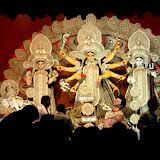
This is what I understand: the city shut down. The women – conspicuously under-represented in any public enterprise – were everywhere, sequins glittering on saris and ruffles bouncing on little girls’ swishing cotton and gold-lame skirts. The artistry was instantaneous; the bamboo polls that had been sitting, lashed upright with string in towering structures for weeks, became more real than the overflowing sidewalks and slowly molding apartment balconies with overnight cotton bunting and steel nails and hay and plaster and paint and glittering idols and real electric chandeliers.

Durga’s eyes are everywhere in Kolkata, all three of them with a bride’s wide nose ring drawing a perfect curve across her lips. They peer at you from the rear-view windows of auto-rickshaws, they gaze from billboards and sit silently inside roadside shrines by the dozen.

This is what I understand: Durga is a conglomerate, a goddess created to defeat a demon who thought he’d worked a way out of the system. She carries the weapons of ten gods in ten hands, and two of her children are incarnations of the same goddess she represents. Her sons are the sons of that goddess, of Parvati the good wife and Shakti the formless female energy.

Kalighat, known for its bloodied goat bodies and incessant beggars, is the name of our nearest Metro station. I’ve never been inside the temple, but I drive by its subsidiary burning ghats every day on the way to and from work, and twenty-five percent of the time I notice my co-commuters marking the passing with a gesture of respect.

This is what I understand: in the season when the natural light fades, we celebrate its memory. Diwali is the Hindu festival of lights, and like the gods it represents, it comes in a million iterations. Diwali follows Dassera, which is Durga Puja, and Diwali is for Laxmi, but Lokhi Puja comes between the two here because Diwali in Kolkata is Kali Puja – and you always worship Ganesha first, for auspicious beginnings.

The air was thick the night I walked home with my neighbor, but we could almost breathe when we stopped on the bridge and watched the hand-detonated fireworks blooming over our affluent neighborhood. The streets, as they should be, were carpeted with the cardboard shells of sparklers. Earlier, when our knees were close to buckling, but all the cabs were going the wrong way, we stepped inside what had been an artic tundra populated by polar bears for a global-warming-aware Durga and was now a haunted house for a bloodthirsty Kali and would soon be a soccer field for the boys team.

Kali was deep in a cave, protected by her terrific handmaidens, bare-breasted women with long tusks and longer hair, their hips wrapped in tiger skins. This Kali wasn’t just an image of a woman with a blood-red tongue and a necklace of skulls; she was the tongue, a long pinkish gash in the Styrofoam stone immediately suggesting humanity’s passage into the world through a pair of garish oblong purpled lips.

This is what I understand: we celebrate what we love, and what we are terrified of, and they’re usually the same thing.

[Note: photo albums of both Durga Puja and Kali Puja are available on my Picasa account]

Thursday, November 6, 2008

The Importance of Getting Out to Getting Back In: Navratri in Ahmedabad

This post represents the third part in a 4-5 part series on The Days of Awe: Rosh Hashanah, Eid, Navratri, Durga Pooja, and Yom Kippur

The Importance of Getting Out to Getting Back In: Navratri in Ahmedabad
October 5-7, 2008

On Saturday, I disintegrated; the pillows wouldn’t hold me properly, and the voices on the phone disappeared into static. When I finally met an open set of arms all I could keep down was a chemically flavored mango smoothie and when they called to book me a plane ticket for the next day I doubted my well-tested ability to get to and from airports and hotels on short notice.

I love to fly – but it’s the familiarity of the ritual as much as the expansive views of clouds, the chance to sit in a controlled space and put life on pause for a few hours as much as the chance to land somewhere new, that fills me with softly buzzing energy as I step out of the car and set my bags on the sidewalk in front of the glass doors leading to the ticket counter. In the airport, I stood up straight, unloaded a hastily packed hiking pack on to conveyer belts, and paid exorbitant prices for a donut that I munched through while waiting in a snaking security line. I imagined there was a soft, self-contained smile on my face, but it was probably just a smug grin at the ironies of the world and an Indian businessman’s ongoing outrage at the price of airport tea (ten to twenty times street price).

At the gate, I read quickly through the Ahmedabad entry in my friend’s copy of an India guidebook, determined to get the embarrassment of being seen with it over as quickly as possible. On the other side, I parked myself just past baggage claim and made a series of phone calls, arranging the yellow brick road for trekking, traipsing, and the possibility of tripping.

The afternoon air was warm, but drier than it had been in Kolkata, and I tried to relish the difference. I was meeting a co-worker for a regional meeting the following day, and he picked out an ashram from the six Bible-thin pages of the guidebook I was now doing my best to keep buried deep inside a shoulder bag. A green and yellow auto decorated with Aishwarya dropped us off, and we wandered into a winding, low-ceilinged series of quotes and photos retelling the adventures of a young lawyer named Mohandas Gandhi. His letter to Hitler – a copy of the original, printed on plain A1 paper – mixed with a calm river view and a man quietly demonstrating how to spin cotton thread outside simple living quarters to pass on a sense of a deeply held philosophy, a syndicated definition of justice, and an effective set of social action tools.

I left with the strange sensation of having eaten a nutritious, filling meal, and when we returned to the hotel, I knew it was time to set out on my own. Still referring to the guidebook, I surreptitiously set it on the counter, and asked the hotel clerk to point out the way to a nearby mosque. He pointed me across a bridge, and the thick pink sunset air wrapped around my ankles as I looked out at the lines of yellow lights marking industrial cranes downstream, at the polluted water glistening in the new moon, and over at the bustling market spilling down the far bank and almost into the water. I felt calm and separate threading between stacks of freshly carved end-tables and carts of locally made ice-cream, stepping over trash heaps ready for pickers and squeezing just past a crowd of bargains in the making. As the headlights of a hundred commuting rickshaws rushed around me, an old woman grabbed my arm – or maybe I grabbed hers – and together, her unfairly beautiful daughter a few steps ahead, we made it safely across. We smiled, and smiled again, and I picked up my pace to avoid a conversation in a language I was embarrassed to still not speak.

On the left, as I was looking for a right turn, I saw it. An ancient stone façade, one elegant story high, glowing with sanctuary lights, and bordered by a dark courtyard. When I stopped just past the gate to ask an old man in a skull cap if it was ok for me to go in, he suggested I ask an anonymous caregiver who seemed to have disappeared by the time I stepped around the ablution pool and into the halo glow of Ahmed Shah’s Mosque. A dozen men were scattered inside, concentrated near the center, but spread between a small forest of carved pillars and ancient domes. The guidebook had mentioned that this mosque, reputedly one of the oldest in Ahmedabad and built in 1414 as the personal prayer place of the founding king, showed a rare blend of Hindi and Jain architecture, mixed with the traditional Islamic vines and geometries. I stood on the edge of the prayer space and traced the hybrid stone patterns holding the ceiling above bent backs wrapped in soft white kurtas and felt, for the first time since the Days of Awe had begun, that I was praying in my own way, pausing and reflecting and asking and telling softly.

I stepped backwards and skirted the pool, admiring the glint of the streetlights on the shallow dark water, and slipped back to the street. I pulled a scarf over my head, as much to deflect stares as for any sense of modesty, and followed the thoroughfare through another market, past strange fences and empty corners, to the Sidi Sayed Mosque, the one I had left to find. It was dark now, and the sunset prayer was just ending. I asked a woman sitting on a bench near the pool whether I could go inside, and she smiled back and nodded vigorously, so I left my shoes tucked near her seat and treaded across the flagstones. This mosque was less ornately carved, but I followed the guidebook’s recommendation to inspect the finely carved stone jali screens – each one centered around a depiction of the tree of life, and I thought about a carpet that my mother happened to give me when I was just the height of the roots to the branches and a song we used to sing in Hebrew school on Sundays.

On the far side of the street stood a twice-recommended restaurant, and, holding a precious image of sitting alone at a table with a rose and a book and a candle in my mind, I followed a uniformed boy up the clattering elevator shaft. On the roof, a warm evening breeze played with the loose cloth of my linen pants and the bits of blonde fuzz that always escape my ponytail to tickle the back of my neck and the edges of my face, tourism advertisement-style. The lights of the city were flashing, but not invasive, and the sounds drifting up were entertaining but not distracting – the world was carefully insulted and heightened, and I folded my legs beneath me on a low wooden bench to begin an epic thali.

The meal seemed to fill in bits of my mind that had been sitting empty, servers drifting in and out of the dark, my thoughts following the flavors up and down the mountain roads that had been preventing any sense of stability. An hour later, the wind picked me up and carried me off to bed, where a smiling woman with orange hennaed hair and cotton saris met me on the neighboring cot. We watched a television awards ceremony and spoke in clips and drifted easily to sleep underneath the accommodating grumble of the air-conditioner.

The second day was for the meeting, and it passed quickly in power-point presentations and planning and government procedures. After the cards had been traded and smiles worn down for the day, we were invited to join in a Garba, a traditional dance gathering to celebrate Navratri. Navratri is celebrated most thoroughly in northwestern India, and I was variously told that it was Diwali, that it ended with Diwali, that it is a dance festival, a pooja, or a preparation. The meeting had been held at one of many offices of the world’s largest union, in a building overflowing with brilliant, empowered women, and as I came down the five flights of stairs, I realized that most of them were dancing in a shaded concrete courtyard.

As I reached the edge of the crowd it opened timidly and engulfed me immediately. The spinning women relieved me of my bag, and of my reluctance to join, and pulled me quickly into a snaking line. I stepped in and out, picked out the other white-blonde face I was supposed to meet, and soon she was pulled into the swirl as well. We imitated steps and swished our wrists, we was spun out and in circles and back in to the morass until we were drenched with sweat and my muscles were twitching with a strange combination of exhaustion and the pounding music.

By the time we had arrived at my host’s home, an hour before dinner, women all over the city were still dancing. Her apartment stood in a strange brand-new development wasteland, shiny gaping half-finished infrastructure stretching out towards the darkening horizon, and the courtyard was full of women in chiffon and sequins, polyester blend silks and shimmering threads, taking turns at a fenced-in rectangular grass dance floor.

I hardly slept that night, but a voice came through the static of the phone to smile and in the pre-dawn light at four thirty the next morning I ventured through the deserted streets of Ahmedabad to wait at the gate and board a series of three flights and hold a little boy on my lap whose mother was traveling alone and enjoy the food service that they’ve abandoned in the US. And I knew that it was ok, that something had been sown up, some flapping window shades had been pulled tight by the glow of old stone and the ever-mystic roof-top breeze of the night before and that even if I began to disintegrate the way I had the day before I left these closures would keep the sand from slipping and I’d have a chance to build a driftwood fort on the beach and stand up to see the reassuring line of the horizon. I stepped out of the easy air-conditioning of the airport into moist air, taxi slip in hand, securing in the knowledge that this was my third landing in Kolkata and that this time, I was home.

Saturday, November 1, 2008

F(e)asting: Eid and Yom Kippur

This post represents the second and fifth parts in a (potentially) 5-part series on The Days of Awe: Rosh Hashanah, Eid, Navratri, Durga Pooja, and Yom Kippur

F(e)asting: Eid and Yom Kippur
October 2, 2008

I intended to move my fast for Yom Kippur forward, to place it during Ramadan so that I could share it with some of the city’s residents, but the calendar got in the way. Instead, I was unexpectedly home alone on a pleasantly gloomy weekday afternoon when I was invited to break the fast I’d never started. It was Eid, the feast after last day of Ramadan, and when I arrived the host was watching a documentary on climbing Mt. Kilimanjaro, in Tanzania. By the time the other guests had arrived, the mutton biryani and stewed chicken and sweet vermicelli were flowing, and by the time I left it was clear that last year’s memory of an unintentional two-day fast combined with this pleasant closing meal and the upcoming Hindu festivities had ensured that I would never start the ritual pause I’d just celebrated completing.

Wednesday, October 29, 2008

Power Cuts, Prayer Books, and Baking Silver: Rosh Hashanah

This is the first in a (potentially) 5-part series on The Days of Awe: Rosh Hashanah, Eid, Navratri, Durga Pooja, and Yom Kippur

Power Cuts, Prayer Books, and Baking Silver: Rosh Hashanah
September 30, 2008

When the power went out and the conversation swirled between English and Hindi and sincere smiles, I blessed the newly lit candles with bumbling words and hands brushing the light towards my face. An hour earlier, I stood on the front porch of my office, leaning against the square grided iron screens and watching the polluted and overcast skies for glimmers that might suggest three stars had announced the beginning of the days of awe, nibbling at a chocolate cookie with a white fudge chunk in the center. Before the meeting and the power cut, I had been frantically downloading recipes, searching through vegetarian instructions for conjuring eastern European food that might create an imagined Jewish feast for my friends.

The streets by my office are effectively still the streets of a village – the caged chickens ready to be butchered for your table and pocket-sized stores selling Haldiram’s snacks and paan are the same as any in Kolkata proper, but some of the buildings behind them are more plaster than concrete, and the tallest tower just two or three stories, interrupted by the occasional five-story apartment building with shiny metal gate and clumsily uniformed watchman. The streets are still being paved, and during the day men sit in dotis and tank-tops, crushing bricks with hand-held hammers so that the red refuse can be scattered across the dirt lanes and topped with tar in an ever expanding network or semi-drivable surfaces. As we walked through the streets, we saw that the power cut had affected the whole area, candles sitting in shop windows and the distant lights of the central and south sections of the city mixing with generator-powered beams and the blinding headlights of auto-rickshaws to illuminate our way. The first evening of the New Year passed in an easily mixed-up combination of dark and light and greasy and fermented and abstract utilitarianism and self-authored scripts.

The first morning began early – the famous stench of the streets made it easy to give away the last chunk of my breakfast bread to a young woman and her tiny daughter begging in front of the chipping white façade of St. Andrew’s church. I turned to see two new friends walking towards me from out of town, interested and intent but reluctant to be up at this hour. We threaded together through an alley, and a man sitting on a ledge in a white kurta pajama and matching skull cap waved us through the heavy wooden doors. Inside, the Beth El synagogue reminded me of others I’d seen in India; a raised pulpit in the middle, a flimsy wooden balcony for the women, dark wood benches holding a strange pile of underused religious materials, a recess and a stage for the torah, and a general feeling of a rectangle filled with light but rimmed in aging blue and white paint.

We ignored the middle-aged white man sitting with a prayer book and a safari hat, grabbed some of our own, and settled on the benches. We dissected a section of a pamphlet retelling a holiday parable, and explained ourselves in barely overlapping stories to the man in the hat, who took more interest in us than we did in him. We were thinking of going, thinking we’d circle and click and soak just a little more, when a venerable man with a walker and a retinue of three came bumbling through the door and stopped by the side of the pulpit to bless a prayer shawl and wrap himself and consider standing for his service before he gathered his tiny following to sit in a circle of the dusty benches under the only circling fan in the room.

We introduced ourselves to the most talkative of the group.
Mordechai Cohen.
Where are you from? From here?
Oh, we’re from Iraq, Iran.
[A glitter pause for effect.]
Well… we came from Baghdad 200 years ago. So yes, we’re from Calcutta.
[A wide smile.]
And… my wife, she is French, born here while her father was on assignment with the English army.
And these men are the caretakers?
[We gestured to the ones who had let us in]
Oh yes, we’ve always had Muslim caretakers for the synagogues. One lives in the basement, the whole neighborhood is Muslim. Always better to give your gold to the thieves for safe keeping, right?
[Again with the glitter pause. We smiled politely, and I privately interpreted this as meaning that they would be safe from extremists in a mono-religious neighborhood.]

The man with the walker was David Nahoum, last resident of a powerful family, proprietor of the famed plum cake sold at a third-generation bakery in New Market, and final holy man of the barely-used synagogues of Kolkata. He led a short service, mumbling through the standings and sittings and turnings, while I flipped back and forth through the all-Hebrew prayer book and picked out familiar phrases. A handful of Americans studying abroad in Kolkata joined us, and pulled a magical packet of apples and honey from a bag to share. After the service, we wandered around the synagogue, snapping photos and murmuring comments. As we left, Mordechai Cohen and his wife Aline offered us rasgullah, a classic local sweet to ensure that we would have a sweet new year.

As the four of the last thirty-five Jews of Kolkata piled in to a taxi cab, we walked with our new friends through the puja-ready roads (it was a market day for market days) to a second synagogue, Magen David. Magen David’s bell tower soars four or five stories above the street, and one or two above its closest neighbors, but we had to squeeze past a stall selling plastic barrettes to get to the lumbering metal gates. When we reached them, we never imagined they’d yield, but the strings of locks and chains were connected only to themselves, and a nearby vendor stepped aside to push his weight against the metal bars. We stepped in to a strangely well-kept courtyard, and were eventually joined by two hurrying, smiling, traditionally dressed Muslim men, who led us in to the synagogue. Magen David was the imagined form of Beth El; the columns supporting the balcony were solid and stone, rather than wood, the balconies themselves lined with wrought metal banisters. Everything about the place was robust, recently repainted and burnished and dusted. We asked who had paid for the restoration of a place so seldom seen (on Fridays a young man lights candles, alone, in Beth El and Magen David while the other three synagogues lie completely dormant), and got a non-answer in return.

After the dim light of the tomb-like sanctuary, the bustle of the streets, even as we passed through the downtown Government sector, seemed to lift us up and carry us along on a stream of tea vendors, bus exhaust, and business chatter. We ate lunch on the sidewalk, gulping grease and fresh-squeezed juice under the sign for the Foreign Tourist Railway Booking Office. I’d been here once before, on a ferry from Howrah – the massive station on the far side of the river – and knew we were near the water. We strolled down to the docks, dodging painted buses and grass-infested railways crossing guards, and scouted for a spot by the water. Like the banks of any good river in an industrial port, the Hooghly is lined with trash heaps, temples, opportunist stalls, laundresses, bathing men, and splashing boys. The water is determinedly brown, without any hint of blue – depending who you ask, either the result of the waste and chemically painted idols dumped routinely into its flow, or a simple matter of heavy silt carried downstream.

The Hooghly feels far from holy, but it’s an offshoot of the Ganges, on her way to meet the Bay of Bengal. We tiptoed down towards the water, edging our sandals against the serrated concrete to keep from joining the tide. We gathered by a trash heap, and read a prayer, and distributed some bread. Then we retreated into our own worlds, and tossed out the breadcrumbs, counting out the habits, the memories, the patterns, and the thoughts of the last year that the coming one could do without. We feasted, for the second time, on apples and honey, and wobbled with sticky fingers back up the bank.

The afternoon was spent in escape – at a bookstore café, gathering vegetables and names, resting in the dim light of another late-afternoon power cut. As the day gathered towards evening, people trickled in and food began to stack up on the counters and soon there was sizzling and scouring and scampering and, a few hours and a dozen guests later, dinner. The table was circled with the semi-agnostic descendents of Jews, Christians, Muslims, and Hindus, and spread with braided bread (tomato flavor, not round), figs, a beet, wine, two colors of grape juice, and our third round of apples and honey. We blessed the collection of ritual oddities, and replaced them with more substantial food. We ate, and ate again, and finished with Bengali sweets while discussing the nature of the baking silver used to decorate the diamond squares of nuts and ghee and jaggery. As the darkness outside settled, Regina helped with the dishes while cards were dealt and elbows began to lean on the table in pairs. The wine bottles were opened – eventually – without the help of a corkscrew, and we raised our motley assortment of tea cups and glasses to toast beginnings, new and old.

Saturday, October 11, 2008

Around the Bend: A Travel Novella (Part II)

June 13th-July 10th, 2008
Leh, Ladakh, and the Nubra Valley, Jammu and Kashmir State

Also featuring: Kolkata, West Bengal; Varanasi, Agra, and Fatehpur Sikri, Uttar Pradesh; New Delhi

[Note: continued from the previous post – please read Part I first!]

Chapter 5

When the valley floor started drooping in beautiful wrinkled camel-colored folds, like a forgotten wool coat thrown over the back of a chair at a winter dinner party, we were too busy feeding our own stories into the quickening breezes to realize that this was the beginning of the valley. When the floor dropped down – not just by a hundred yards, but by half a mile – we straightened up on the bike and then leaned forward again into the wind, we pulled over between freshly blinded curves and exhaled into the vastness. We felt giddy and alone and perfectly integrated with the undulating road. We laughed at the occasional Jeep blasting its horn at a passing army truck, sorry for the passengers locked in a metal box.

We roamed down the mountainside, and sped along a tiny indented road rushing a little above the valley floor. We watched passing oasis towns – created by glacial runoff in the otherwise spectacularly brown and blue and metallic landscape – grow and shrink. We came to a crossroads bearing a yellow sign that shouted ‘Diskit!’ and we tucked in and sped across a miniature dessert. Sand dunes rolled out to either side, and soon they were swatting our faces, pinching our cheeks and slapping our hands with a thousand immaculate grains of sand. Halfway across our little Sahara the raindrops began – and it seemed a miracle that they didn’t mix with the dirt in the air to splatter us with mud – so that we were being pelted by hot dry hard grains and cold wet soft drops until the mountains reared again and we went up up up and left that silly sandy little flatland down below.

We switchbacked and straigtawayed and honkingly blind curved our way for another twenty kilometers, until, with early afternoon sun melting our memories of a night in North Pullu, we passed the first tilled fields and thin swaying poplars and white gompas and low stone walls of our new home town. There was a closed ‘Peace’ restaurant and a ‘Main’ street and we swung through not-quite-right until we parked by a small stream running downhill from the town prayer wheel. We walked under a gompa, ducking unnecessarily and tracing a tiny path to a beautiful courtyard and a tree house hideaway room with a cloth ceiling and two walls of windows looking out on gardens and hillsides and buckets of hot water and glasses of fresh mint tea. We settled.

Later that afternoon, when Vam and I turned the curve of the main road, bending it in our minds to fit ourselves into this isolated town’s image of itself, we recognized a lanky blonde figure waving from the upstairs window of a restaurant – Mar and Ty had made it safely to town, and soon there was feasting and guest-house touring and tall tale telling. There were adventures the next day – Mar and Ty sampled the next metropolis’s debatable delicacies, and Vam and I popped both wheels on the bike, failed to get them fixed, and ended up in a ‘bar’ set up in the open space of a man’s family farm, eating sliced cucumber and tomato and trading tall tales of 1999.

In the morning, Ty had disappeared, returned early to Leh, and as the three remaining adventurers, Vam, Mar and I decided that the slow spread of roads across the Nubra demanded our company for leaning, singing, speeding, slowing, frolicking, and general criss-crossing. We dined on Ladakhi bread and local apricot jam, we slept under the windows and lapped up the stars, I let the thin sunlight dry my hair and blow through the clothes that would take too long to wash – and soon we were ready to go.

Chapter 6

The Diskit gas station consists of a distinctly unprotected pump, set in a clearing of slightly more regular gravel than the dirt-and-broken-boulder landscaped surrounding it. Off to one side, a low building houses the station attendant – if you need a fill, just knock on the door. We did. Soon we were spinning back across the miniature Sahara, and this time the yellow concrete sign shouted ‘Panamik!’ as I slowed down to turn left and we saluted the armed men guarding the infant desert. The road to Panamik was a pleasant jigsaw puzzle of landscapes – low curving hills and sharp cliffs against unvarying plains, sand spilling across the road in slippery dry sheets and low-land marshes flashing our reflections back at us, malicious thorn bushes and graciously welcoming green trees bending slightly in the breeze to wave us by prayer wheels and low white farmhouses and cows and the odd bus.

All three of us noticed a resemblance to our mental images of life in the Roman Empire.

Stepping down from the bike, I felt like a hero in a Western. I discovered a miraculous macaroon, and Mar pulled us all into the Hot Spring Guest House where a casual old man fussed in a thatched kitchen filled with blackened metal and produced a brilliant dal. We settled in to our rooms, and discussed rebellion on the low rooftop and admired the mountain-stunted view from the northernmost point a tourist can go in India. We ate a dish that approached Chow Mein (too familiar, at this point), but Pakistan and China both stayed stubbornly hidden, for all their physical proximity, behind the rosy peaks.

In the morning, Mar took me to the hot spring to admire the moss, and we skipped around puddles and talked about romance in the travel-sphere – bathing was suspicious, but the guest house had a direct line, and I cleansed my body, if not mind and soul in a soft blue plastic bucket of earth-temperature water. On the way back to Diskit, I soared, and Vam picked me up and carried us both up to a hill-top monastery that left the distance we had just ridden a little line in the palm of our hands. That view of the Nubra valley immediately pre-sunset was the most beautiful doll-house spectacle I have ever seen.

We all turned in early, and snapped our eyes open at five am to retrace our steps past the curves, high roads, low marshes, desert folds, epic snowline, all cut by a fresh serving of unadulterated light and Christmas-morning views ready to be unwrapped and gasped and cooed over. We held close and let go and ate crumbles of crackers, until we arrived back in North Pullu. The bases looked different in the light – smaller, more commercial, less ours – and we posed for photos and turned our wheels upward towards our old friend.

Two or three kilometers later, in the middle of my babbling, Vam slowed the bike. He had an apocalyptic look on his face. A handful of cars passed us by. None of those that stopped had an air pump – until two massive olive green carriers pulled over, and two dozen soldiers poured across the road and swarmed over the bike like so many camouflaged ants. They refilled our front tire and left us with enough air to reach Station 49, and the conclusion that it was a bust, not a small leak. We sat on a half-broken stone wall and kicked our frozen feet into the mortar and looked up. The station soldier disappeared into his half-oil-barrel home to make us tea and Vam announced that we were stuck again, stuck for good and stuck together, and I couldn’t stop smiling at the utterly complex simplicity that this trip had lent to our lives.

Another pair of riders pulled over, and I discussed foot tattoos with a beautiful Brazilian woman in white while an Australian man helped Vam to examine our newest bump. At eleven am, just on time, a volley of empty cargo trucks pulled out of North Pullu and started folding back and forth up the foothills towards us. The first one to pass pulled over at a wave, and offered to carry us and the bike to Leh for about ten dollars. We shoved the bike in the back, jumped in the cab, and waved our new friends into the distance, promising a celebratory dinner that evening. The truck was classic – decorated to the proverbial hilt with small plastic pieces, painted flourishes, dented and buffed aluminum crowns, and hand-painted cursive messages to passers-by: ‘horn ok please,’ ‘permit J&K state,’ and the like. The interior was equally effusive, with a quilted plastic ceiling bearing dangling hearts, a dashboard filled with stickers of important monks, a handful of surprisingly unfaded photos of the driver’s family wedged above the rear-view mirror, and Tibetan pop blasting on the radio.

Chapter 7

At Khardong-La we stepped on to frozen ground and smiled at the captain who had rescued our friends and snapped a few shots and meandered quickly back down to town. On the edge of it all, I sipped a luxurious mango smoothie while Vam wrestled the bike down from the truck and collaborated with half the mechanics on the street to repair the wheel. Soon we were tripping back to town, and eventually stumbling in to a ground-floor room at a miracle hostel that came with a library, an internet café, and a rose garden patio. That night we dined on pizza and lemon meringue pie by a crackling fire and we clashed in the moonlight in argyle and green and woke up entangled in the unreasonably adorable and ever shockingly fictitious tourist scene of Leh.

Leh wrapped us comfortably together, just slightly exposed, and spit us out on two consecutive mornings. After Vam left, while I was still lingering and he was negotiating the youth hostel in the unimaginable morass of Delhi, Mar and I crossed a different valley and climbed a different (small) slope and found a modest palace and a power plant and a series of large high-schools that must serve whole swaths of the valley’s villages.

In Delhi, Vam was standing outside the domestic terminal, and I smiled and we quickly got lost together in the freakish familiarity of Connaught Place. That night, on a shiny new train near a shiny new baby on her way home with her posh young mother, we watched the clouds stack and shuffle themselves to form a hundred different stained glass windows across the plains of northern India. We woke up in Kolkata, West Bengal to join a Rainbow Pride March before stumbling through the thick air towards edibles and restables and after the clarity of the mountains it felt like equal parts mental and physical metropolitan marsh – overflowing with ever-lingering afternoon rains and street side vendors whose homes suspiciously resemble their shops and shirts sticky with emotion clinging in the damp air.

The morning presented the towering remnants of the British Raj – beautiful old buildings and super sleek suburban malls, all mixed with leftist politics and famed Bengali poetry. On the ferry, Vam and I counted the types of transportation we had taken over the last three weeks, and smiled at the total: bus, bike, foot, truck, airplane, train, rickshaw (auto and cycle), taxi, boat. We had stolen a block of time, and twisted it to our liking, and now reality was trying to snap back to the shape it was used to holding. I waved out the back window of my yellow taxi cab as he disappeared, black t-shirt twisted at the shoulders under a heavy backpack, in to the wandering crowds of commuters.

Epilogue

I arrived in Varanasi with a brand-new chest cold from the journey and a pair of German friends picked up at the railway station in an attempt to out-smart the auto rickshaw racket. Sabri and Ann and I tripped up five flights of stairs to the roof-top dorm room, but the mesh walls seemed insufficient protection against the mid-monsoon rains, so we settled for cupboards with miniature windows for fifty rupees each. You make friends quickly when you travel alone.

Varanasi fascinated me for its proximity, its associations with death and water, with recycling and renewal. It presented me with the worst side of tourist-ready India, with heavy monsoons twisting the river and clouds obscuring the bright colors of the city, streets streaming with trash and cow patties (making dodging massive bulls in tiny alleys even more dangerous). My stomach twisted and my fragile sense of belonging balked at the offers of opium and obscene rides. The fourth of July passed on a roof top restaurant with my new friends and a trip down Jack Kerouac’s road, as it was meant to be traveled. On my last night, after viewing and considering and cleaning and preparing, we ate with the monkeys and watched the light fade and I felt better for knowing that I’d been and was ready to say goodbye.

At the station, I saw a head of blond hair far lighter than my own and we locked eyes and giggled and I sidled over and dropped my bag in imitation of hers. She was Finnish, and offered me a made-up name, Anne, when I tripped over her given one. We laughed at the ridiculous spectacle that Shiva’s city had laid at our feet, we laughed at the late train, and laughed at the habit of wandering the globe in circles to come home.

On the train, I was mistaken for a Canadian – always a compliment – and slept above a handsome German couple and across from a set of Bangladeshi Muslim clerics on pilgrimage. In the morning, I was cured – my chest was empty, my head was light, and my feet moved me of their own accord to book a ticket on to Delhi and a hostel for the night. Agra is not a place to stay. Agra is a place to stop through – Anne bought a ticket out for that very same night.

I visited a fort and a tomb and settled into an inner dialogue on the intricacies of carved stone and empire building and life as it had been passing in India. In the morning, I woke up just after sunrise, and entered The Monument with the first dozen visitors. The light was dull, but the white marble glowed like the oversized toy of a young prince, opalescent and immaculate and utterly secure in its own grandeur. I walked slowly, and made friends, and left them to walk in patterns formed on a whim and embedded with meaning after the fact.

Floating on my morning’s visual feast, I wandered on to a flaking teal bus, and followed my elementary school instructions to sit at the back (because other people, at other times, have been forced to sit at the back of the bus, so we who have the choice should sit there and leave the front for those who are older or otherwise require or enjoy the ease of the front). I was joined by a figure I had noticed that morning, watching the inlays glisten in the gloom of the inner tomb – a young Englishman, Ken, on his gap year adventures. We exchanged recent life stories, leaving bits buried in forty kilometers of upturned fields, and when the bus dropped us in Fatehpur Sikri, Akbar’s imagined capitol, we turned up the trash heap together, and were instantaneously married in the eyes of the hawkers pushing silver necklaces and glass beads and guided tours. We spent the next hour trying to shake off our self-assigned young guide, while looking up and out at the massive mosque we had entered, and the half hour after that climbing the next hill and feeling guilty because for once, this man had not asked for anything from either of us.

The Moghul Emperor Akbar’s court – abandoned after twelve years because the water had not been properly engineered and the new capitol was traded back for Agra and Delhi – spread before us, and for once I matched the squares in the guidebook with the stone blocks rising solidly on all four sides. My favorite pillar – and it’s important, when faced with so many beautiful carvings and so many monuments to pick favorites, otherwise it all blends together into one red stone wall – was the throne pillar, a fifteen-foot high seat connected to surrounding balconies by small passageways, so that Akbar could arrange clerics of every religion around him in a circle, and conduct theological debates with the hope of coming to some consensus. The clerics staged an uprising, and Akbar had them all killed for attempted regicide – but the seed idea was fascinating, and the pillar was decorated with symbols from a dozen faiths.

That night, on the train to Delhi, in my heavily sweat-stained shirt I matched the moon to my music, and the woman sitting next to me asked how many years I had lived in India. I smiled. At a wandering friend’s air conditioned home I unfolded and cleaned and prepared for re-entry. My head was still floating, prepared to look down at the expected marshmallow clouds. My hands were still, my clothes filthy, and my gifts stacked carefully and wrapped in one another to prevent breakage.

At the airport gift shop, I filtered through a pop-up version of the Kama Sutra, and thought about arriving in Delhi and hating the filth and loving the mountains and settling in the south and stretching my legs up and down the country and returning to the one place I felt in place for this extended vacation, and I decided that I don’t like to travel alone so I chatted with a beautiful British-Bangladeshi Nokia rep and we agreed that they’ll try to take you to the newest mall, but there’s so much to see and its all changing so fast that we were lucky to have visited and would be coming back soon for more.