Sunday, October 21, 2007

Should I bring my own chains?

‘Should I bring my own chains?’

‘We always do.’

- I ♥ Huckabees

Definitions, thoughts, and addendums to the entry ‘Making Headlines:’

1. Definitions:

a. GG4L = Goode Glaciers for Life! My (absolutely benzoes) unit at Camp Orkila, where I worked, lived, laughed, and sang with a cabin full of nine-year-olds for four summers. So much of what I learned and became at camp informs every random corner of my life… the Moose song (about a Moose who likes to drink a lot of juice) is only the beginning.

b. Idly = a small patty made from rice flour and a certain type of ground lentils (idly dal)… you mix the powder with water, it ferments and thickens… you pour the dough into round moulds (idly makers consist of a few levels of these) and steam for 10-14 minutes… the flavor is slightly sour, and reminds me of sourdough or that delicious Ethiopian bread…

c. WPF card = A snazzy AJWS business card printed for the World Partner Fellows… they’re not personalized, and just contain the contact information for the NY office… but in a land of business cards, they’re useful as social bartering material.

2. Thoughts:

a. My mother asked a very reasonable question: if I try not to make eye contact with men, how do I work with them all day, let along travel with one? To amend any previous statements: I try not to make eye contact with men I don’t know, unless I need something from them (aka auto drivers, shop owners, etc.). In the office, I try to treat everyone in more or less the same way… and kindly but firmly reprimand anyone who calls me ‘dear,’ or a ‘good girl.’

b. In answer to an AJWS questionnaire about settling in: I'm really lucky in terms of my work situation -- I have my own desk and a column on the team's monthly work plan. My office has a crazy work ethic, which has fired up my own drive and gotten me integrated into office life faster than I expected. Of course, things are far from perfect, and after some seriously strange media coverage on my first set of field visits (see blog for details), my next project is to put together some ethical guidelines for media + children + AIDS (and in my case, + white people) to distribute to our offices and partners.

c. Indian English is its own language. Some examples of common words used at work which I’m certain are not ‘proper’ English: updation, learnings, abusements. Some words that are recognized by spell-check, but are used much more frequently here: felicitated, cadre, miTigaTe.

3. Addendums:

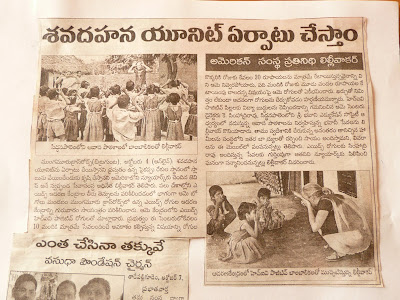
‘We will start a unit which will be helpful for death ceremonies for HIV+’s’


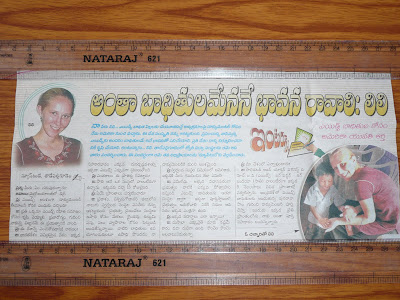
‘We should feel that we are all suffering: Lily’


Monday, October 15, 2007

Making Headlines: Crematoriums, Suffering, etc.

Aka My First Field Visits, October 3-8, 2007

It was just after 8:30 pm when I shouldered my hiking backpack (the one I had been so happy to unpack just two weeks ago), said goodbye to my flat-mates and the prospect of a candle-lit simchat torah dinner, and skipped down the stairs into the end of the rush-hour bustle on Tarnaka-Secunderabad road. After a few tries, I found an auto driver willing to not cheat me, and landed easily on the black marble benches of platform 1, Secunderabad Station. Minutes before our train was set to arrive, my co-worker, M, called, and we pushed (only sort of politely) on to the A/C triple-tier sleeper car. One brief night of fitful rumble-filed sleep later, we stepped down into the warm, slightly wet air of Nellore, the capitol city of the coastal district by the same name. Our hotel was nice, the cable TV stations were even nicer, and we picked up breakfast (idly, of course) at an open-air restaurant on the way to the bus station. The two-hour bus ride to Kavali was occupied by intermittent napping and smiling at a girl about my age taking hundreds of cell phone photos of my white face. [Note: children and women get a smile in return for pointing a camera at me, men get a glare, and I try not to take direct photos of people whom I haven’t met.]

M woke me as the bus driver pulled, apparently arbitrarily, to the side of the road, and as I stumbled down the steps, we were met by two grinning young women – the project coordinator (PC) and the multipurpose health worker (MPHW) who implement my NGO’s OVC program at the grassroots NGO (lets call it NGO-A for this entry) we were about to enter. A small white archway, painted with red lettering and red ribbons, announced the entrance to a compound of three buildings set around a courtyard occupied by a few motorbikes, benches, and a woman setting a baby to rock in a sari cloth draped from a small fruit tree. We were ushered into the main office, and served tea with a side of introductions. We were then promptly ushered back out, and through the care wards. In the first building, the patients stood to meet us, or sat up and spoke from their metal cots stretched across with netting and laid with sheets. They looked weak, a little haunted, but their smiles were broad. In the second building, which M unnecessarily translated for me as the ‘terminal ward,’ the skeletons wrapped in skin, fingers tapping lightly to pass time, chests expanding slightly for attempts at breath, could barely turn their heads. There were no introductions here, and we passed, a small procession of prosperity leaving a grotesque exhibit, quickly back into the sunlight.

While M reviewed the records for our OVC program with the PC and MPHW (in Telugu, of course), I made faces at the children appearing around the edge of the office door. The grinning kids couldn’t speak any more English than the women in the office, but they were happy to communicate by other means. With a ‘it will make them happy’ from M, I stood up to go and play. The little ones disappeared. I peered out of the barred, glassless window. Three faces were peering up, but giggled and dropped down at the sight of my own. Hide and seek had begun. Eventually, after passing through an animalistic snarl-smile game, this turned into a full-on version of Simon Says / do-as-I-do, with a growing audience of older women looking on. We danced. They sang for me. We did somersaults. I touched the ceiling; we waddled on the floor. Eventually, it was time for lunch; meat curries and the special Andhra chutney (leafy greens fried in spices??) with white rice on a banana leaf.

After lunch, we loaded onto an auto and a bike, and took the smooth highway roads out to a tiny town where NGO-A runs an orphanage and school. I asked them later why they had started it. ‘Because,’ the NGO head explained, ‘when we started the care and support center it was one of the first, as part of the state AIDS control program, and people would leave children at our gates in the middle of the night. So we built this to take care of them.’ Practically all of the resources used to build and sustain the orphanage are drawn from the local community – the villagers donated the land, and the labor and materials to build the dormitory and schoolroom. A local TV station did a segment on the home, and decided to donate school uniforms. My NGO provides school supplies, doors, chairs, etc for the classroom. A local businessmen provides enough money to pay two teachers – the NGO head’s wife and brother-in-law work for free as an additional teacher and caretaker.

As we entered the school compound, eighty-odd children, from maybe three to eleven years old, filed out of an open classroom, and sat in a perfect grid, giggling at this strange young woman being offered a nice plastic chair and a cold Limca soda in front of them. After some language-strangled introductions, a talent show began, with individual and group songs, dances and exercises. I taught the first verse and chorus of ‘a great big moose’ (GG4L!) – they made excellent moose antlers, although I’m pretty sure there aren’t any moose in India. They taught me their aerobics routine, and then asked me to lead it. We tried to play elbow tag, but when this seemed to dissolve, they taught me a very different version of hide-and-seek (it involved me being blindfolded with my own dupatta in a large circle of children, trying to track three of them by the sound of their voices). The afternoon wore on, and villagers trickled in, standing quietly at the edge of the playground to watch. After some more official business, and a dash of logistics in translation, we climbed back into the auto to the sound of many ‘good-bye Lili’s (the difference between the vowels in my name are quickly lost in any other language). The buses weren’t coming, so M flagged down a car, and we rode quickly back to the lights, the hotel food, and the Samuel L. Jackson HBO comical-cop movies of downtown Nellore.

With a slightly better night of rest, and a proper set of idly’s behind us, M and I met the PC and MPHW for NGO-B… who had waited breakfast for us, so… after another set of idly’s, and a short car ride to an upper-middle-class neighborhood of Nellore, we left our shoes at the door and went in to meet the director of NGO-B. NGO-B is well established, and provides a wide range of resources; they work in disaster relief and preparation along the coast, in HIV prevention and support services in nearby slums and villages, on income generation projects for the old and disabled, sustaining traditional arts. While M, the PC, and the MPHW leafed through home visit and support group registries, I read the National AIDS Control Office (NACO) policy on Children and AIDS (with a little dozing and a lot of water in the morning heat). For lunch, we were invited to walk a few doors down to the home of the NGO-B head; there was a pile of sweet carrots cooked with mustard seeds, dal made with dark greens (to be dribbled with pure ghee butter), fried greens with chillies, tamarind and white rice, curd to cleanse the palate, fruit, and a strangely green ice cream with raisins and cashews for dessert. We feasted.

After lunch, we traveled to what I thought would be a slum, but was actually an urban clinic in a nice neighborhood. The beds inside were empty, but a woman in a light purple sari occasionally walked in and out of a door marked ‘counselor.’ Left alone, I dozed in a chair. Eventually, women, different ages, draped in different colors, some matching, some wearing tired cloth and tired expressions, trickled in, trailing toddlers in khaki shorts. They sat in a circle on the brilliantly white tiled floor, and when the PC and MPHW joined them there, I sat as well, smiling greetings with enthusiastic head wobbling to try and make up for my complete lack of language. The meeting – a support group for care givers of children infected or affected by HIV – began and soon M joined, asking their permission for me to take photos. I looked at them through the lens, and listened to the cadences of the conversation. Three quarters of an hour passed, and we waved goodbye, trailing schoolchildren’s stares as our car pulled away from the clinic.

On the way home, M stopped to grab a copy of the district newspaper; a newspaper which contained a strange article about someone named ‘Lily Walker’ who had visited NGO-A the previous day, and promised to build them a crematorium, to provide daily funds for the orphans, and to fix their roof. The photos with the article were clearly of me, although I remain sure in the fact that I barely spoke with the NGO-A head, and mostly just played with the children (providing, of course, such lovely pictures). Back at the NGO, M and I observed a second caregiver’s support group, reviewed more files, talked some more official office talk, looked at photos of programs supported by our NGO, and waved goodbye as the sun was setting. Another night of HBO – John Tucker Must Die – which I justified with our ten-hour site visit days and an intense desire to communicate in fluent English, even if my conversation was with a television screen.

I woke up mentally prepared for one final site visit, and one overnight train home. When we entered the painted metal gates of the large compound of the Sisters’ church and NGO-C, the first things I noticed were the crosses painted on the low wall complemented by a haloed statue of Mary in the center of the driveway. The road leading in was lined with trees being hung with lights for the impending saint’s day feast, and we passed a church and a playground before stopping at the main office. The sisters, Roman Catholic nuns, wore cream colored cotton sari’s, long silver chains laying a cross to rest in the middle of their chests (the silver seems significant in a country where every woman who can even marginally afford to wears gold). The Sisters welcomed us to a dining room, and fed us with tea and sweets and savory chips before ushering us on to an office set aside solely for our OVC program. NGO-C’s main activities center around a home for ‘differently abled’ children; they have a school, vocational training, physical therapy, and a dormitory. The sisters also do outreach work in nearby areas, and it was through this work that they became interested in HIV issues. After the requisite record-reviewing (while I read about access to medicine in India) and expansive lunch-eating – the centerpiece was a special fried fish this time, as sisters eat plain foods – we left the comforting compound for a trip to some nearby villages. Leaving Nellore proper for the neighboring mandal of Kovur, we drove across the top of a damn, an adventure akin to driving through a shallow estuary; however, it seemed to be a main road out.

Our first stop was at a government-funded school run by NGO-C for disabled children. It wasn’t the school children, however, that we were supposed to interact with. A self-help group for HIV infected and affected children was run on the porch, and it was those children, along with a handful of widowed parents and grannies, that we were there to meet. There was an exchange of names, and of songs, and since we did not have time to stay and teach, I sang the refrain from ‘Be Blessed’ (Ebony Singers spring ’07!) in return for a Telugu tune about Jesus’ love.

Back in the car, and past an increasing number of raised ponds ringed with palm trees and small fishing huts, we pulled up an increasingly thin dirt road to the middle of a small but bustling village. Down an ally and around the back of a house we found the meeting – a group of maybe fifty children seated on tarps and facing a row of empty chairs. Assorted mothers and grandmothers sat in the back row, learning against the palm-leaf-roofed houses, pulling the youngest kids in and out of one another’s laps. M, the PC, the MPHW, and I sat down as the panelists, but quickly took a back seat to the usual Music and Dance Revue, which included my rendition of the first verse and chorus of ‘River’ (for those Islanders who care to know). We then embarked on a rousing round of ‘head, shoulders, knees, and toes,’ as they taught me the Telugu word for each body part, and I taught them the motions. The children learned quickly, but an old man in the audience, one whose mind was never quite anchored to this reality, had the biggest and the most glowing grin of them all.

As we waved goodbye, and they clustered together, an elementary school rumble broke out over the opportunity to stand near and wave… and I momentarily felt like the coke bottle in ‘The Gods Must be Crazy.’ Led in the opposite direction from where we’d come, the path back to the car brought us to the front porch of a man living with, and dying from, full-blown AIDS. Handsome, but wasting and match-stick thin, with two grinning, momma-sari-twisting young boys, he spends his days on a cot placed on the porch, partaking as he can in the life passing by along his street. I smiled, unsure of what was expected of me, and M exchanged some sentences I had no hope of following. We left, ponds flashing by as we deserted dirt roads for the highway, and a more direct trip back into town. When we returned to the Sisters’ compound, it was glowing, every fence and tree, every window and eve strung with multi-colored Christmas lights. Over tea and sweets and savories, we recorded our impressions and thanked them for the visit. Their smiles were warm and their genuine enthusiasm palpable as they explained that to gain the people’s trust, they wanted to offer more than information, they wanted to offer services. We smiled, warmly, and left.

Time for dinner, time for shower, time for train. Time to get a phone call from another NGO partner, in another district, begging us to please come to an event the next day in West Godavari. They would pay for everything. Weren’t we already in the field? A business man would be giving one lakh (one hundred thousand) rupees worth of nutritional supplements away to HIV affected children, and having a rep from our NGO at the event would just make the whole day. The volunteer could come too. The possibility of this actually happening fluctuated, so at the moment that I was lying on the top bunk on the train, inches from the air conditioner, pages from finishing ‘God of Small Things,’ and only so many hours of transportation away from my very own bed in my very own apartment, it still came as a surprise, a sort of a mind-game, that M and I would be getting down from the train at Vijayawada sometime between one and two am, and hiring a taxi to drive us two hours through the night (sleeping in the back seat with luggage as a pillow) to Tadepallegudem where we would sleep another two hours in a decently accommodated hotel. But it did actually happen, and after it actually happened, I actually watched most of a modern Lassie movie on television before breakfast had been served and cleared and showers had been taken, and I actually almost cried when Lassie drowned in the river. She probably came running miraculously back over the hill, but that would have been after we had already left.

The approach to the event hosted by NGO-D was not promising. The building looked half-built, and we climbed two flights of newly poured concrete stairs with no right hand wall before emerging onto the second floor, which was rather conspicuously missing the back wall. The room, however unfinished, was packed with over two hundred children, caretakers, NGO staff, and media, with a massive pile of all of their accumulated footwear announcing the crowd at the entrance. I was introduced to a dozen men, none of whose titles I could hear over the garble of giggling, crying, and generally restless children. As the day ripened, and the guests of honor had still not appeared (the guests of honor having clearly no appreciation for the work of the mothers trying to keep their kids relatively still in the massively packed room while nothing in particular happened), some of the braver twelve-year-olds came over to introduce themselves and sit with me. When the guest of honor finally did show up, and I was asked to sit at the front of the room, I continued the smile-sillyface-frown-wink-smile game with the kids in the front row to pass the time as a series of speakers talked about what I presumed was the importance of fighting AIDS and helping children. After speeches (including a rather forced and translated one by yours truly) came handout time, with a massive milling confusion snapped into frames as each child was held by the arm and posed to receive their gift while the donor received a promo photo in return.

I photographed, I handed out, I played hand-clapping games with a little girl in denim and a polo shirt. I smiled blankly at adults, and more sincerely at children. I gave away the AJWS WPF card when I was asked questions above the din. Finally, I ducked away to the office of NGO-D, to a fresh-cooked lunch, and to a journalist waiting for interviews and photos. After my recent bizarre appearance in the Nellore district paper, I wasn’t sure that journalists were a particularly good idea, but decided it might be worth giving my own words a try, with minimized answers about my own life and maximized answers about NGOs, and how ‘we’re all affected by AIDS.’ So there were more photos, more words, more NGO tours. There was waiting and showering and eating under disco-lights. And then there was a bus, with a reclining seat that un-reclined as I slept like a prop in a Charlie Chaplin movie, and that dropped us off twenty kilometers outside of Hyderabad at seven-thirty in the morning because it lacked a permit to enter and security is high these days.

I arrived at work early monday morning, left my luggage behind my desk, brushed my teeth in the office bathroom, and ordered idly for breakfast. A few days later, my office received some news clippings in the mail. ‘We should feel that we are all suffering: Lily.’ ran the headline. The subtitle read, ‘A strong feeling of an American youngster for the victims of AIDS, Interview.’
Tuesday, October 2, 2007

Of Trains, Rains, and Potholes

I said it best in shaky handwriting, bumping happily down along half the length of India on a pseudo-sterile blue pleather bunk:

September 16, 2007, 10:37pm

Woke to sick Becca. Early morning taxi down the mountain with golden light. Own baggage to train. Nap, views through thick scarred yellowed windows. Finished ‘Moor’s Last Sigh’ [by Salman Rushdie]. Strange uplifting in absurdity. Recognized road to Anna’s apartment in Delhi. Back to sweaty station. Boarded 21-hour train to Hyderabad. Bad food, ice cream. Hot gross bedtime. Liminal. Under water?

September 17, 2007 (written a few days later)

Train, train, train. Woke up to Myla hip bump. Read [Monstrous Regiment] in bed. Breakfast in bed. Lounged in bed. ‘Got ready’ for day. Sat on bed. Started ‘In Spite of the Gods: the Strange Rise of Modern India.’ Lunch (plus apple and P.B. later) in bed. Beautiful shifting views, blue-tinted bed-side window. Talked the talk with Myla and Shlayma. Hung out of train. Hung out in train. Chandra from NGO met us at Secunderabad station. False start, apartment! Through the rain for food for the masses. Wander in sleepy apartment-home. Hyderabad has clean air – crazy language.


And so it was that seventeen World Partners Fellows left Dev-Dar-above-Mussoorie for a few hours in the still-steamy grime of Delhi, and that six WPF left Delhi for Hyderabad (the other eleven boarding different trains for different journeys). We were met, we were ushered, and in turn we ushered Adam on to Vijiawadda and Leah and Lauren on towards Patta Patnam (?), somewhere past Vizag.

And then there were three: Lily, Myla, and Shlayma (in alphabetical order – or by height). In a fairly nice neighborhood enclave in a fairly spacious, fairly ugly flat. With grey-white marble floors and black detailing. And pink walls (some more peach, some more decidedly pink). And a brown table with brown upholstered chairs and a clear plastic table-cloth dotted with brown flowers that were not meant to be brown in nature. We have two bedrooms, four beds, two toilets (one Indian one Western), two small enclosed balconies (one for Laundry, one for Contemplation), and two glass-covered cabinets cluttered with a fascinatingly horrifying collection of inherited kitsch.

So we sat, the three of us, on our (astonishingly brown) chairs and pretended we had enough energy to figure out what we needed to make the apartment our home. This part of the story is rather fuzzy and worn-out, or perhaps just never recorded in my short-term memory; the weather was pleasant, the neighborhood full of little allies that would possibly all make sense in a month or two. The street we were shown to Go Buy Things on was Big and Busy and Overwhelming. The stores were overpriced (or rather, we were brought to overpriced stores because it is assumed that since we are white, and American, we have lots of money and a strong desire to spend it). The water availability was hopeful but confusing (no hot water; a shower head but that bathroom rarely has running water; constant water supply to the rest of the faucets but refill the tank but don’t overfill the tank so maybe you won’t always have water but usually you will). When we went to bed, our second night in the city, our first night alone in our apartment, we were exhausted and disoriented, but we were Here. And we hoped that being Here would be Enough.

On September 19th, we woke to tea (boiled for ten minutes in a frying pan on our gas stove) and toast (also frying-pan style); we pulled on our salwar kameez’s (purchased in Delhi, matching scarves pinned awkwardly under the shoulder straps of our bags), and scattered into the streets towards our respective offices. Chandra, who had met the six new AP residents at the train station, knocked on my door precisely fifteen minutes after we should have left, and my first commute began: 45 minutes, 50 rupees, a million roadside shops, and plenty of exhaust. We bumped a vegetable truck, we scraped along the side of over-flowing buses, we cut across oncoming cadres of motorbikes, we stood still in parking-lot traffic, we raced towards billboards with Tollywood stars splashed across them. As tantalizing as all this is, I’ve invented two games to entertain myself during the daily journey from Tarnaka to Musheerabad and back: one, try to elicit a smile from any other woman stuck in traffic (while never making eye contact with men), and two, attempt to memorize the name of every single storefront along both sides of the road. This should take me a while.

My first impression of my NGO’s office was that it is beautiful. Set on the third story of a nice residential apartment complex in a middle-class neighborhood, it has high ceilings with cream molding and softly spinning fans, glass-front cases filled with books, pamphlets, and conference programs on HIV/AIDS, and a small pooja-room (not because anyone in the office seems to be particularly religious, or that the staff is overwhelmingly Hindu, but to make the organization feel more like a family). The NGO has three offices, two in India, and one in New York, which run a wide variety of AIDS Advocacy programs. Two programs are run out of the Hyderabad office: one that focuses on PMTCT (Prevention of Mother to Child Transmission), and one that focuses on care and support of OVC (Orphans and Vulnerable Children) and their families. I work on the OVC project, in a room with three mustaches, and my very own desk. I have documents to read, and data to enter, and soon I will have projects to begin. Life at work is good.

Life at home is very much in transition – hopefully, at this point, a transition to being settled in. We cook each other dinner. We light candles, and found sticky-sweet wine for Shabbat. We hang our laundry on the Laundry Balcony and try to remember to cover our shoulders and knees when we do. We stay up late watching movies in a pile of mango candy wrappers. And last weekend, we took an adventure across the city to the shiny, mall-infested land of Banjara Hills… which is another world, and another story, altogether.

Notes:

  1. Our apartment is in Secunderabad. My NGO is in Hyderabad. And they are in the same city. So, what may once have been “twin cities” have clearly merged – as far as I can understand (and I can understand practically no Telugu, which is the heavily dominant language here), they even have one city government. In a vague sense, Secunderabad seems to be north-east of the lake that sits at the center (of what?), while Hyderabad is everywhere else. In a vague sense. In India, names change frequently, and nothing is very well labeled, but everyone gets where they’re going in a fairly reasonable – depending on the weather – amount of time.
  2. I have been asked, by AJWS, not to use the name of the NGO at which I will be working for the next nine months in my blog, just in case my blog (and personal opinions) are what comes up when some random person on the planet decides to google the organization. This sounds reasonable to me. I’m also not supposed to use anyone’s last name. Sounds like a plan. We’ll see how confusing this gets, and if I have to make up a secret code, or start inventing fake names.
  3. Trains: self-explanatory. Rains: still monsoon season here. Glorious. If you know how much I love rain, because this is serious rain. Potholes: the road back from work is having new pipes laid under it. The cement is torn up, and it’s a semi-construction site, but that doesn’t stop rush-hour traffic. It does, however, cause you to occasionally hit the ceiling of the auto.

Wednesday, September 26, 2007

L’Shanah Tovah

Greetings from a new, new year. I’m sitting in my Hyderabadi apartment with my two flat-mates, Myla and Shlayma. We celebrated Rosh Hashanah with full group of fellows up in the mountains… and Yom Kippur as a trio in our new home: an as-yet-undecorated, marble-floored, pink-walled flat in an unknown, monsoon-soaked city of six million. It’s been quite a transition. My thoughts for the Jewish near year have been lost and found in various corners, but my overall meditation on life as it is beginning in ‘Incredible India’ (as the tourist slogans go) comes from Trudy (that philosophical bag-lady standing on the corner of walk-don’t-walk):

“On the way to the play, we stopped to look at the stars. And as usual, I felt in awe. And then I felt even deeper in awe at this capacity we have to be in awe about something. Then I became even more awestruck at the thought that I was, in some small way, a part of that which I was in awe about. And this feeling went on and on and on… My space chums got a word for it: 'awe infinitum.'

Because at the point you can comprehend how incomprehensible it all is, you’re about as smart as you need to be. Suddenly I burst into song: 'Awe, sweet mystery of life, at last I’ve found thee.' And I felt so good inside, and my heart felt so full, I decided I would set aside time each day to do awe-robics. Because at the moment you are most in awe of all there is about life you don’t understand, you are closer to understanding it all than at any other time.”

The Search for Signs of Intelligent Life in the Universe, by Jane Wagner, performed by Lily Tomlin

Note: yes, this is the same play I played with in my thesis. And yes, I’ll be working hard on my awe-robics this year. ‘Nuf said.

Thursday, September 13, 2007

To Review (chronology is overrated)

“The first thing I noticed about Bombay, on that first day, was the smell of the different air… the next thing I noticed was the heat.”

From the opening of Shantaram, by Gregory Roberts

“To understand India at all, you must be able to hold on to completely contradictory images, and realize that both represent the true India.”

From the introduction to Culture Shock! India, by Gitanjali Kolanad


To review: we landed in Delhi, to the smells and the thick air (and the airport parrots). To go even further back: I found some young, vaguely Jewish looking folks at the London Heathrow airport, and we gathered into a small crowd. Name, school, NGO assignment for the year. Memorize, forget, repeat. The words couldn’t come fast enough, and were followed by distinctive pauses, stating ‘I know almost nothing about you.’ Hello stranger, thank god for Cadbury’s chocolates on British Air. I watched Teenage Mutant Ninja Turtles on the flight (yes, the new animated one – we can discuss this later).

So customs was easy and our luggage arrived and, sweating profusely and gulping bottled water, we climbed into two taxis. We knew to expect cows in the road. We did not know we would see them grazing on the jersey barrier in the middle of ten lanes of traffic moving through a space designed for four. Traffic lines, in India, are more like suggestions – very general, subtle suggestions which may be easily ignored.

We arrived at a sprawling pink hostel in the embassy district of Delhi (not exactly a neighborly area) with more young, vaguely Jewish looking folks (aka white, in our new context) who had arrived the day before. With a few quick introductions by Anna (our in-country AJWS program coordinator), we were released into the teaming, steaming streets. I jumped into my first auto-rickshaw (think a motorcycle with a small open-air European-sized car loaded on the back) with two other girls, Myla and Becca, and headed for Conaught Place. Conaught place, a fairly central and fairly upper-curst area of New Delhi, is made up of a series of concentric circular roads surrounding an underground market topped by a park. The buildings in the area are tall, dirty white, curlicued images of aging colonial architecture. The shopping there can be high-class – United Colors of Benetton sits on the inner circle – but we wandered up and down the spoke streets, and I found a loose sequined cotton blouse for a few dollars. The question of whether or not to wear Indian-style clothing here isn’t just one of tourism, voyeurism, whiteness, etc., but one of comfort and commodity; that “India fab” (not to be confused with FabIndia, a clothing chain) garment has saved me from unbelievably gritty hot weather (but back to such complicated questions of assimilation/appropriation later).

After learning to dodge traffic (again, traffic lights are more suggestions than anything else), and landing safely back at our Pink Palace, the fellows (two still in the air somewhere) were loaded in a bus and shipped out to a suburb to visit Sunita, AJWS’s Volunteer Coordinator for India. She had a feast for us, but the comfort of spending a few hours in someone’s home was almost as filling as the fifteen varieties of sweet and savory. With an early evening and an even earlier morning, we met our last two fellows, plus the NY program director… and twenty of us (17 fellows, 3 staff, along with many boxes AJWS papers) boarded a bus out of Delhi and up into the mountains.

The beginning of the trip was beautiful, but uneventful. It was difficult to tell when we left Delhi, as a mix of suburbs, road-side vendors, and small towns seemed to stretch continuously for hours out of the city. Eventually we emerged into miles of rice and sugar fields, taking the long way around certain towns; Independence Day was imminent, and celebrations were blocking many major roads. But the real excitement came when we reached the bottom of the foothills of the Himalayas, and began a seemingly endless climb up into the clouds. The road we were on was not precisely a one-lane road, but it barely fit two cars passing one another, let alone two buses. All of the curves were blind, and none of the fencing along the edge (short concrete buttresses – if there was anything at all) looked as if it would stop a fall. Our bus’ horn was blaring constantly (except at the cows, who clearly deserve more respect than that) as we tried not to look down the sheer green drop a few inches from the wheels of the vehicle.

It was dark when we arrived at our destination – an education-focused NGO* with its own campus past Mussoorie, past Kempte Falls, and past Kempte Falls Villiage. They had recently expanded their programs to include a gap-year residential college, and we stayed in gender-segregated open dormitories. That night we climbed blindly up their hand-made steps (reconstructed after the recent rains)… but in the morning we were greeted with a stunning view of the surrounding mountain-hills. At our little retreat, we learned crucial skills: how to use squat toilets, how to eat dal and rice using a chapatti that can be torn and handled only with your right hand, how to deal with upset stomachs, and how to focus a camera on distant hilltops. Our days were filled with AJWS sessions on development, Indian history, and NGO politics. We climbed up and down the NGO campus, ventured out to nearby town-outposts, got up at 6:30 am for yoga with the gap-year students, and watched Planet Earth on DVD (the mountain episode was especially educational in our setting).
*(an NGO which Barb Crook worked with in the mid-90’s!)

After a little more than a week of sitting in circles and talking alternated with walking up hills and staring, it was time to pack once again, time to wind back down the slithering roads to Delhi. The plan was: a few days in Delhi, a few more educational sessions and some time to explore. Next, those fellows with placements in the north (Maharastra, Gujarat, Uttar Pardesh) would return to Mussoorie for Hindi classes, while those fellows with placements in Andra Pradesh would head to Hyderabad for Telugu classes. Instead, after a few days of adventures and conversations, after a lovely closing dinner, the Southerners were gathered and told that two bomb blasts had been set off in Hyderabad just a few hours before. Our train tickets had already been canceled, and Sunita would meet us at the hostel the next morning to discuss our options.

(the story, from here, picks up at the "... and then I woke up in a bad reality tv show" post. chronology is overrated.)


P.S. Coming attractions: the adventures in Delhi, Old and New, deserve their own meandering post, to be written some day soon.

Monday, September 10, 2007

Where the Ganga flows out of the Himalayas

(Haridwar: a weekend getaway adventure)

When we stepped out of the taxi in Deridun, the first thing we noticed was the warmer air. The second was the large brick bus station in the distance. It was surprisingly empty – less than a third of the thirty-plus bays had dilapidated metal buses parked and waiting for the scattered passengers to enter. Vendors selling every form of snack food lined the interior of the building, but business was slow. When the bus to Haridwar pulled out of the station, the three of us traveling together – Rachel, Myla, and I – constituted over half the passengers. But when the bus pulled out of the station, the driver stalled at the entrance to the major road, and the bus quickly filled up – not just the seats and the luggage racks, but every inch of the isles were packed with bodies. As the bus rumbled along, young men or middle-aged couples would flag us down and attach themselves to the doorway, squeezing up the steps or simply hanging off the side.

Haridwar is a small, holy, tourist-ridden (Indian tourists, mostly) city that marks the spot where the great Ganges river flows out of the Himalayas. From the highway, it looks like a long cluster of pink buildings above long, smooth steps that line the rushing, brownish Ganga. Thousands of figures can be seen along the banks, bathing, drinking, and collecting the holy water. A massive statue of Shiva, wrapped in a leopard skin, his trident resting on the bank, overlooks the scene. From its main causeway, Haridwar looks like many other Indian cities we’ve passed through. It is full of rickshaws – pulled by horses, men on bicycles, and small motors – full of mobile fruit stands, chemist stalls, ‘hotel’ restaurants, women in beautiful colors, men in sweaty blue work-shirts, and children selling and begging. The bara bazaar, just an ally away from our accommodation at the Hotel Om, seemed to specialize in prayer beads, red powder for ceremonies, and a saffron cloth printed with variations of “om” mixed with images of Shiva and Parvati, Ganesha, or Krishna.

As we meandered through the stalls, and slowly sweated out the bottles of water we had consumed that morning, we began to wonder if we might be ‘lost,’ and whether we had any idea which way was ‘out.’ So we turned left, past a tall yellow brick façade, under a dirty archway, found ourselves on the bank of the Ganga. Crippled beggars – one pushing himself along on a small wooden board with three wheels – mixed with holy men and everyday bathers. I walked towards the steps, hoping to rest and watch the astonishingly polluted but beloved water flow by, but the stares we got as we walked closer were far more reproachful than the usual wondering looks, and we decided to keep moving. Soon, we came to a bridge overlooking a famous ghat – at this spot, Krishna supposedly left a footprint on the bank, and dropped some sweet nectar. Every night, thousands of people gather at the sound of chiming bells for a ceremony in praise of the river. As we pressed in to take photos of the gathering masses, we were blocked in by a police barricade, apparently put up to keep worshipers from storming the river during the ceremony.

The sun was settling when prayers began to blast out of loudspeakers rigged to the bridge and nearby temples. Small leaf baskets, filled with flowers and the flicker of candles, which had been floating slowly down the river, began to be released in greater numbers. Most of the bathers climbed back up the steps, and official representatives spread out through the crowds to solicit donations (receipt provided). As the light from the sky faded, bright torch-like balls of flame appeared in white-robed priests’ hands, flames leaping and falling to the ground as their bearers swayed, burning oil splashing on the river bank. We made friends with our neighbors on the packed steps, who explained some of the prayers, and invited us to visit them at their flat in Delhi. As the ceremony ended, and the police barricade was lifted, worshippers flowed in and out, young girls marking our foreheads with yellow and red for a donation of a few rupees. After watching the crowds, thousands passing up and down from the water, we wandered away from the Ganga with an Israeli friend we met on the banks, and drifted off to dinner. Electricity (and therefore fans, as well as lights) flickering on and off, disco-style, we fell asleep.

The next morning, we got up early to see a few sights before returning to our scenic but chilly language school. Just around the corner from our hotel, and up a short alley past red and gold wedding attire, we found the base of a cable car running up the side of a foothill to Mansi Devi, a temple to a goddess who will grant all your mind’s desires. Jockeying with the Indian tourists, we boarded small Disneyland-esque open-air cable cars, and rose up above the city (there was even an old Mickey Mouse statue in the atrium). The ride was surprisingly relaxing, and we stepped off the swaying cartoon-yellow car onto the crest of the hill. From the cable-car, we were swept into the small bazaar that has grown up around the temple, selling offerings, jewelry, and the like. Through the vendors and past the shoe deposit stall (key: bring a bag for your own shoes), we elbowed, shouldered, and pushed our way into a single-file line between shoulder-high red metal fences leading into the actual temple. Inside, there was no open space, but a series of shrines, with different offerings to be given at each. At one, people dropped incense into a fire, and marked their foreheads with ash, at another a man patted my back and head; above an amorphous orange figure, worshippers tied red strings around a tree, and at the central shrine people threw baskets of offerings to priests who looked like dock-workers, catching and passing the gifts towards a statue of the goddess.

On the way out, as Rachel and Myla combed the stalls, a couple asked if I would take a photo with them. This seems to happen a lot – even more to me because of the blonde – but I was still surprised when they handed me their infant to take a photo of the two of us. Indian babies are used to being passed around, and the tiny one quickly fell asleep in my arms. Since I had been in many people’s photos, I decided it might be alright to ask for a photo on my camera as well, but the whole experience was as strange as always. As we left the temple, I saw the young couple in the crowd, and we smiled and waved. The swinging cable cars brought us back down the mountain, and Myla and Rachel and I boarded a series of crowded buses back to Mussoorie.

Of course… we stepped off the bus and right up to the head of a parade in honor of Krishna’s birthday. Children extravagantly dressed up as various gods, and perched on the back of open trucks, with music blasting, chugged past. Frequently, the parade stopped and some of the older god-actors descended to the concrete to act out a story as they lip-synced and danced to the music. The crowds were heavy in the narrow mountain streets, but the sights were worth every moment of being pressed from every side. As we walked towards the taxi stand, wondering if we would ever make it up to our guest house through the winding traffic, I stopped for some jalebi (dough deep-fried in clarified butter), and we rode happily up toward our welcoming mountain home.

Friday, September 7, 2007

Living Vertically

A little over a week ago, we were given 5,000 Rps and a train ticket for six (2nd class AC, with veg meals, very high snazz) to leave the land of limbo*. The tales we had heard about Indian train stations and cars were fantastic, but whether due to the early hour (there is something distinctly unnerving about sweating so much at 5:30 am in the Delhi morning heat) or a state of over-anticipation, the trip was happily uneventful. Carnival-color-flashing scales for weighing bags, English/Hindi mutt signs, beggars sleeping in the middle of trampling feet, porters carrying suitcases twice their weight on skinny necks, teal-blue faded train cars pulling in, filling up, pulling away. We carried our own bags, stuffed them above our own seats, and settled down to catch up on the sleep we had missed the night before.

*(Anna’s – our in-country program director – apartment in Delhi, with the daily question of whether we would be traveling north or south, learning Hindi first or getting started on Telugu, and whether that uncertain beginning would happen this afternoon, sometime tomorrow, or in two weeks)

This being India, of course, the notion of sleeping because there might be nothing better to do was quickly debunked. A constant stream of food – water, tea and crackers, hot breakfast, more tea, mango juice – and adorable twin Sikh boys running between our seats and theirs to shake hands and say “hello, hello” kept me awake and wondering. Five hours and endless sugar (?) fields later, we stepped off our rocking metal transport and into the distinctly cooler air of Deridun. Anna met us at the station, fed us, and packed us into taxis to climb back up the switchbacks to a little nook of the Himalayan foothills just a town or two away from our first orientation destination. And so The Southerners rejoined rest of the fellows at the Dev Dar Woods guest house and the Landor Language school, about 4 km or a half hour walk above Mussoorie.

The trees here are dripping with green. Green climbs sideways up the short stone walls that hold in the hills, green slicks the soles of our shoes. The color swings from branches with grey-white languor monkeys and insinuates itself through the cracks in the bedroom floor.

Our Hindi classes are alternately speeding and crawling along. When clouds drift in through the door – I mean marshmallow puff passing over the threshold, visible and prickly and soft – I smile slightly and turn back to the next new letter. When the electricity goes off in the middle of a lesson, the teacher continues without a pause, and the light inevitably flicks back on a few minutes later.

The views off the sheer sides of the foothills are cottony white. When the curtains part, they reveal a sea-green coral carpet of trees covering folding mountainsides. And if we’re very lucky, if enough layers have been lifted, if six of the seven seas have parted, we may glimpse the white-gold tips of the real mountains. The Himalayas laugh. They would laugh at our pathetic gasping lungs, out of air from climbing these little precursor mounds, but we’re far too small to merit such grand attention.

Four of us took a seven-hour meander on Saturday. Although we began with a dirt-trail descent past guest-houses and forested homes, we soon stretched along a major paved road. With our cross-strapped backpacks and sweaty American t-shirts we must have cast a strange image to the small boy who carries water up and down this slope every day, to the girls giggling in flocks on their way home from school. When we finally left the road, escaping context, we pranced under power lines and scrambled along goat trails that provide barely half a foot of horizontality in this world of vertical living.

Here, everything is either up or down. The sidewalks and roads are not smooth concrete, but are scored to keep cars that are climbing up from sliding back down, and to keep the pack mules that are sliding down from catching too much speed. Unfortunately, there is not a parallel wet/dry dichotomy. Instead, there is a steady continuum from damp to soaking. Damp is preferable, and even somewhat precious. Plain old ‘wet’ is more common. When I don’t want to connect my body to one more soggy-cool surface, I remember the absolute smog-heat of Delhi and try to appreciate my cold bones absorbing one more ounce of chill.

After sixteen hours of Hindi classes, two weekends, one sweet new years, and an untold number of paperback novels and bollywood music videos, the seventeen World Partners fellows will be scattering in the (thankfully hot) winds. Maybe the Southerners will actually get on a train to Hyderabad. I hear the ticket has been bought, and our placements are still set. My apartment is waiting (two rooms, three young women, no air conditioner)… and since we finished the Deva Nagri alphabet today, it’s clearly high time to start in on another…