Monday, November 26, 2007

Strung with Tungsten Stars

November 8-11, 2007
A Diwali weekend

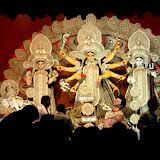
Diwali was tooth-achingly sweet, eardrum shatteringly load, eye blindingly bright. It was deliciously too much, so that every crevice of my innards were filled with rava (wheat) and jaggery (sugar) and ghee (butter) and every fiber of the rest of my mass was brimming with accumulated sensations and sticky thoughts and sky-blue fuchsia feelings.

That afternoon my boss walked through the office with a sparkler and the fire hit the white marble floors and disappeared. It avoided the computers, but lit up the balcony. The children in the street below had been setting off sounds all day, and when it was our turn the roof looked like a small battle zone. As the sun went down, the city lit up and the constant noise pushed palpably against my skin as I rumbled home in an open-air auto.

The cab pulled up outside our flat, my roommates pulled each other downstairs to meet me, and I pulled a bright scarf around my neck. The festivities were beginning. When I was first draped in another woman’s gray pinstripe business sari, I stood up straight and they ood and awed at my height, but soon there was dancing, breathless waltzing carrying a six-year-old while singing ‘I could have danced all night’ and spinning in circles. There were super sweet Indian delicacies, and piles of biryani (the essential Hyderabadi dish – basmati rice cooked with spices and meat or veggies) to be carefully placed in the mouth (the trick is to pinch the rice, then push it off your fingers using the back of your thumb). Soon, I was sitting on the marble floor and playing hand-clapping games, so the perfectly ironed pleats of my dress would just have to accommodate themselves.

We slept. We woke to the high-pitched joyful screams of our young neighbors (three girls, aged 2, 5, and 6, one behind each of the three doors on our landing), and scuttled in circles, giving sweets, taking sweets, shaking hands and admiring new dresses. We were given chapatti stuffed with sweet batter, fried coconut patties, and balls of cinnamon flavored sugar. Then we left for breakfast. Breakfast brought famous dosas and stories about New York Jews and since we couldn’t believe we were still eating the afternoon went by in a sort of a blur. There was lunch (lunch?!) cooked by our new friend’s chef, and television-food comas and lazy discussions of ceremonies.

Then two of us went out in a cab and came back to a neighborhood that we’d never seen somewhere in the city we supposedly know. We were invited in to the living room where we admired the piles of flowers and incense and little oil lamps arranged around the goddesses, and looked apprehensively at the piles of food waiting in the kitchen. When the ceremony started, some time passed before I realized that the daughter-in-law was calling out each name of the goddess Laksmi, and I wondered as we passed number 137 if she would read out the whole booklet, but by the time she got to the last, the 1008th name, I was entranced. Fruits were broken, lotus flowers folded, knees bent, foreheads marked. Each of the little oil lamps was lit, and afterwards, they were placed along the front wall of the house, continuing the fences of fire trailing down every ally.

We were given explosives. Fountains of sparks were set off from the middle of white designs painted on the threshold of every doorway. The ground was littered, but more like carpeted, with wrappers and burned fuses. The air shook and the eyes of the children glowed. We ate, inexplicably, and practiced short Telugu phrases to say that we liked the food and didn’t mind the ironic darkness of a mid-meal power cut when it was nearly daylight outside the house. The ride back, out of Secunderabad and to our young friend’s flat in the Western part of town, was chilly when we passed through the military and Muslim neighborhoods, but something more akin to an amusement park extravaganza as we dodged mid-road blasts in the Hindu areas.

When we walked in to our friend’s home, a second shrine was waiting and so more prayers were said, but these were mostly silent prayers, and requests and thanks to ideas more than to idols. We used the oil lamps sitting by Laksmi and Ganesha’s feet as Shabbat candles, and blessed the fact that we had found white wine while we blessed the wine itself. There was a lot of singing and quiet thoughts, and very little eating of that thing called dinner. Soon it was time to take our own magic box up to the roof and add a few more stars to the planetarium of fireworks. Imagine the Fourth of July, or any normal fireworks show, but 360 degrees, the biggest star bursts lighting the sky over the wealthiest neighborhoods. Smoke blocked most of the natural dome, but eventually more permanent stars peeked around the clouds, and by two in the morning there were conversations between moving lips under the evenly spaced stars of Orion’s belt. And even then, another bouquet of fire hit the ceiling and splashed across our easily blinded eyes. Time slowed down and sped up and ran around the block while we tried to leash it and then gave up and let it go.

In the morning, we ate famous food (but don’t worry, it was late in the morning, and light fare for famous food). We browsed books and talked about titles and Salman Rushdie’s obsessive depictions of strange Bombay childhoods. At dusk, labyrinthine sparkling rocks and strange Jabberwoky cousins slouched or slithered and dematerialized behind the softly bent trees of KBR national park. ‘When you admire nature,’ the signs reprimanded gently, ‘you pray to its creator.’ Peacocks, their hundred Argus eyes closed, stalked haughtily by.

We spent the day digesting the sweets and the lights and the noises and the conversations, and sat bundled on flowered velveteen couches. But when we went out, out to the top, where the dresses are shorter than the ones I’d wear at home, and the table-side fountains are filled with rose petals and floating candles and the dark smooth wood is draped with cloth to evoke the desert oasis of an imagined India, we buzzed with energy. The music danced me. I thought of contra lines and tea totaling jazz ensembles and body isolations and learning to stop pointing my toes and steaming up the windows of the Space Needle with high school hip-hop. To cool off, we returned to the roof, and sat again with the stars and watched the extra fireworks being detonated around the city.

The morning was late as mornings after so many days of excesses should be. In the afternoon we walked by the water (which makes everything better) and went out to visit the new (1992) statue of the ancient (3rd century BC) time when this place was a major center of Buddhist thought. And I stood under the Buddha with a maybe and watched the water stretch and breathe and felt like the city had embraced me. I gave it an A-frame hug back.


(For an alternative telling of the same weekend, with perhaps more straightforward detail and explanatory photos, take a gander at Planet Bollywood, my flat-mate Myla’s blog… the photos that accompany this tale can also be found in my picture albums)

Thursday, November 15, 2007

Elevator Speech

The Assignment (for the World Partners Fellowship):
An elevator speech is, as you may know, the 30 seconds that you have to hook someone before they lose interest. Imagine yourself in an elevator with the CEO of the Gates/Ford/Rockefeller Foundation (okay, a long elevator ride); what would you say about the NGO to make it seem like a good funding prospect? And, in this assignment, how do you describe the work that you’re doing succinctly, but in a way that makes us want to know more? Note that this should be more interesting than just reiterating the organization’s mission or your work plan.

The Speech:
India is home to the third-largest population people living with HIV in the world. My NGO – (spell out the acronym here) – began as a listserv to provide scientific updates and build a network of people working to fight the spread of HIV in India. It has since grown into an organization with offices in Chennai, Kolkata, Hyderabad, and New York, and provides a wide range of services, from family-centered care to support centers for sexual minorities, the second largest prevention of mother to child transmission program in India to the first national directory of AIDS service organizations. The program I work with, (full program name here), works to support children affected by HIV. We focus on the family as the unit of intervention, providing child and caregiver support groups, educational scholarships, nutritional support, recreational activities, advocacy opportunities, and referrals for any medical services we can’t provide directly. We work with ten grassroots NGO partners in five high-prevalence districts of AP, providing additional staff and extensive trainings to help each NGO to scale up their child support programs. My current project is to document some of the best practices of our program, as we plan on expanding it to other high and medium HIV prevalence states in the coming year.

Reading Woolf in a Cyclone

October 28-31, 2007
Advocacy Follow-up Workshops
Nellore
, Nellore, and Eluru, West Godavari
(with a lot of soggy travel in between)

“Now the truth is that when one has been in a state of mind (as the nurses call it) – and the tears still stood in Orlando’s eyes – the thing one is looking at becomes, not itself, but another thing, which is bigger and much more important and yet remains the same thing. If one looks at the Serpentine in this state of mind, the waves become just as big as the waves on the Atlantic; the toy boats become indistinguishable from ocean liners…

‘A toy boat, a toy boat, a toy boat,’ she repeated, thus enforcing upon herself the fact that it is not articles by Nick Greene on John Donne nor eight-hour bills nor covenants nor factory acts that matter; its something useless, sudden, violent; something that costs a life; red, blue, purple; a spirit; a splash; like those hyacinths (she was passing a fine bed of them); free from taint, dependence, soilure of humanity or care for one’s kind; something rash, ridiculous, like my hyacinth, husband I mean, Bonthrop: that’s what it is – a toy boat on the Serpentine, ecstasy – it’s ecstasy that matters.”

~Virginia Woolf, Orlando

I got on the same train, happy to have a Same Train to get on. I climbed up to the top bunk – the safe bunk, the bunk which is least likely to attract random bed-mates or sandal thieves – laid out my scratchy yellow blanket and starched white Simhadpuri Express sheets, curled up around my precious laptop-heavy backpack, and quickly fell asleep. I slept well – too well – and was just beginning to allow the fact that the train had not been moving for some time to seep into my groggy thoughts when K tapped my bunk and said the tracks were flooded. The train had been still for over three hours. Some passengers were shuffling out the door and picking up other transport from the small station across the tracks. Others shook their heads and wondered why any sane person would leave the secure shelter of a train during a cyclone.

A cyclone is caused by a dent in the ocean, they explained, and a dent in the Bay of Bengal had been flooding the southern coast of Andhra Pradesh for the last twenty-four hours. Being far from the ranks of Sane People, K, M, and I joined the sleepy but jumpy brigade of Track Crossers through the rain, and met two of our field workers on the other side. One of the workers was in her second trimester of pregnancy, and despite the size of her belly and the fact that she too had slept on the train, there wasn’t a single wrinkle in her beautifully embroidered silk sari. I was impressed. The five of us crossed a second set of tracks, and entered the small open-air building that serves as the Singarayakonda train station (konda means hill or mountain in Telugu). It contained one ticket window, two simple wooden benches, and a handful of resigned, damp looking men in white linen shirts, their dirty black duffle bags (filled with other white shirts for the next work day) resting by their feet on the concrete floor.

My half-dissolved dreams from the train sat down on the bench with me, and we waited together to see what would happen next. A big white Jeep pulled up outside the station, and with an awkward passing of umbrellas and bags and a careful lifting of saris and slamming of doors, we were inside a new metal box. And unlike the train, this metal box could move in the rain. ‘You saved us!’ K shouted happily to the man in the front seat. Our Saviour, the head of a NGO partner from Parakasm district, turned and said, hands folded and smile beaming, ‘No, Jesus saves you.’ As his driver backed out of the parking lot and into the wet streets, my eyes went to the plastic crucifix sitting on just that spot where Indian taxis tend to have a small statue of Ganesha, Lakshmi, or one of the other pantheon favorites. ‘Oh,’ my almost-awake conscious noted, ‘they must be one of our faith-based NGO partners.’

Satisfied with my brief analysis, and happy to be in a moving vehicle, I settled against the cold glass. Soon we were passing fields of water. Some had been rice patties, some had been sugar cane fields, some had been raised fish ponds, but each side of the highway now formed its own lake. Small islands of palm-thatch roofed huts, a few protected with blue tarps, stood on slightly raised mounds of mud, and the palm trees standing up to their knees in water shook obstinately green heads in the passing gusts of wind and rain. ‘This is important for you to see,’ someone told me. They said it a few times. ‘To see how hard it is.’ They were smiling the nervous smile of someone driving down a very wet road very early in the morning. We passed one car with its nose smashed in and pushed up against the jersey barrier, a bus with its back end firmly in the mud, and a crowd of women with umbrellas who forced us onto the wrong side of the road to get past. They were standing around a woman’s body lying in a strange still pose between the second and third set of wheels of a massive truck. Her blood, if it had been spilled, had been washed away in the rain, but the distance that her mourners kept made it clear that she was dead. One of the field workers from the faith-based NGO (there were nine of us now in the car) folded her hands and began to pray. The driver pulled back onto the left side, and forty minutes later we drove up to our Same Hotel in downtown Nellore.

We were more than a few hours late, and after a brief ‘washing up’ we gathered in a conference room provided by the hotel: field workers and a few directors from our NGO partners in the southern coastal districts of Nellore and Prakasm, the program manager, one program officer, and myself. Switching consistently between English and Telugu, we spent a very Logical afternoon talking about Advocacy, Children, AIDS, Stigma, and Discrimination while the illogical rain filled the city streets outside. There was a heated discussion on whether ‘resource mobilization’ counts as ‘advocacy,’ and therefore whether most of the partners had been doing much advocacy work at all. I presented, with Telugu translation by M and additional Indian adaptations of my ideas by K, on advocacy tactics. The partners made plans and formed committees. There was tea in small ceramic cups and crackers on flimsy paper plates and a beautiful thali lunch where I was taught to mash banana up with my curd rice for dessert. We took a group photo under the fluorescent lights and quickly dissolved at the edges as everyone contemplated the efforts required to get home through the water waiting outside.

None of the trains were running because of the flooding, and the local buses were all filled with displaced train passengers. In the half hour I had to get ready for a second night-time journey, I slipped in the puddle that had mysteriously formed near the door to my room, smacking smartly into the white marble floor. Whimpering to my unsympathetic audience -- a pair of twin beds -- I watched the beginning of Jurassic Park on cable TV while my tailbone got over its initial anger with my clumsy feet. On the way out the door of the hotel, I reprimanded the hotel manager – through M’s Telugu – for not having someone properly mop up the water, feeling both completely childish and utterly justified.

We climbed back into the white savior jeep. I remembered driving through some deep puddles, each a few car-lengths in size, earlier that morning, and tried not to contemplate the condition of the roads we were about to enter. We backed up across the stream that lined the main roads, and trundled out of Nellore. Some roads were closed; on others we passed young men pushing motorbikes, an old man and peddling a cycle rickshaw, its wheels half submerged, water washing softly across the women passengers feet resting on the floor of the little vehicle. It was dark, and the streetlights storelights houselights reflected brightly in the light brown water. Beautiful, in an entirely bizarre way.

As Nellore city faded in the distance the roads changed. They were nice. Recently, the BJP (Hindu nationalist party) had secured a World Bank loan (two of my favorite organizations?) to improve the roads, and even out by small villages the Nellore highways are beautifully paved. Nice, but, unfortunately, significantly underwater. Water lapped at the bottom of our doors. Each time we slowed or stopped the car, a wave washed over the windshield, blinding us completely. We passed a few cars with the passengers pushing them through the waves, or trudging along the side of the road, clothes plastered to their bodies and shining in our headlights. Jeeps had never felt like such a great idea. I felt impervious in our Big White Box. The rain came and went, and each time we entered a grossly overgrown puddle at least one person folded their hands and shut their eyes to pray. We listened to Christian gospel in Telugu and tried to stay away from the ‘horn please’ tails of trucks. I sang my own favorite gospel songs under my breath and smiled down at the waves and wondered at the small crowds of empty vehicles around every roadside building, but we never stopped to join what must have been very crowded cozy damp living rooms.

Somewhere between the waves and the rain and the crinkling of shifting business clothes I pulled out Orlando, by Virginia Woolf, and opened to my precious goodbye-card bookmark. I was almost finished reading it, and this seemed like a suitably dramatic circumstance in which to say goodbye to the young nobleman turned noblewoman extraordinaire. My cell phone has a small flashlight on the end, and I traced it along the glorious sentences. They sounded prophetic against the sound of a million raindrops on metal and glass and more water. Ecstasy. ‘Do you have to sit for an exam tomorrow?’ K asked me teasingly. ‘No,’ I smiled, and read a few more pages.

We passed a handful of tollbooths staffed by plasticized policemen who insisted on taking our receipts back and forth through the torrent. After the third or fourth tollbooth, we passed to dry land. The rain slowed, and stopped completely. The cement with its World Bank Bright White Lines was slick, then damp, then dry. The bushes planted along the middle of the road sat quietly in the still night air. Suddenly, our Telugu gospel sounded even more joyful. We picked up speed, and pulled into a restaurant in Ongole, Prakasm just before closing time. The restaurant was disgusting, and lit with baby blue bulbs, but marginally clean and sufficiently stocked with cold bottled mineral water. We stuffed a few minutes worth of stale biryani into our mouths while staring, exhausted, at the stucco walls, and quickly climbed into a hired taxi.

I slept, cradling my still sore tailbone against the soft edges of the seat as I tried to curve by back to become as horizontal as possible. The driver reached Eluru, West Godavari, in record time, and soon we were rising up a comfortably packaged hotel elevator shaft to air-conditioned rooms on the fourth floor. There was a bed! And it was mine! This was my chance to sleep, horizontal and not in motion. I tried, and when I realized it was hopeless, I watched ‘You, Me, and Dupree’ on HBO. I tried again, and failed, and tried to cry, and failed. I tossed and turned, and succeeded quite satisfactorily at that. A text message lit up my phone: one of our first friends was leaving Hyderabad to go home to Mumbai. Funny he’s just waking up, I thought, and finally fell asleep. While I slept, an English-language edition of Thu Hindu was slipped under the door: the front page story showed a bus floating away, a handful of passengers marooned on its roof. An hour or two later, I woke and showered and dressed and held my head cautiously in my hands while I stared out at the low but solidly real buildings of Eluru. I sipped the orange-flavored Oral Rehydration Salts that I’d brought just for mornings like this and enjoyed the slightly sour squish of fresh idly against the roof of my mouth.

We conducted our second Advocacy Follow-up Workshop in M and K’s hotel room, with partner NGO staff from East and West Godavari districts. The schedule was the same, although the digressions into the relationship between resource mobilization and advocacy were significantly more heated. We visited two District Officials in order to practice Advocating; I sat in the front row and smiled and understood nothing except that we got a few empty promises and a little more rain. When the Telugu stretched on, I wrote a letter to a friend, and after our partners disappeared down the elevator shaft, I started piecing together the words to describe driving through the cyclone for my AJWS telephone check-in.

I put on my traveling-over-night salwar kameez for the third night in a row, and after another blue-lit dinner, I found myself sleepily slapping bugs on platform three at the Eluru train station. Our train pulled in at eleven, and I laid out my top-bunk train bedding as my mind shut off the light in the attic to fall quickly into a rumbling sleep. We stepped down at the Secunderabad train station amidst a light drizzle, and paid a scab cab driver to take us to work at seven in the morning. There was an auto strike on, which was technically annoying, but seemed a small inconvenience after the weather we had recently survived. I let myself into the office, splashed water on my face and daytime clothes across my body, and ate children’s milk biscuits while catching up on email. The work day passed in a pleasant blur, and I walked into my apartment in time for a Telugu lesson and a glorious Halloween dinner.

This adventure was made possible by: the NGO that Saved Us; Myla, who lent me Orlando; Adrienne, who gave me a beautiful little card which I keep as a bookmark; Eleanor, who donated the north Indian cell phone that happens to have a flashlight, and Pastor Monts, who taught me the words to so many gospel songs.

Monday, November 12, 2007

Happy Halloween!


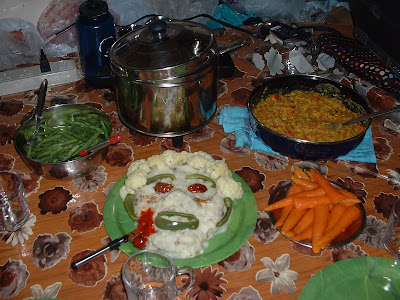
We feasted on fear. And sillyness. We didn't dress up, although some people would count what we wear everyday as a 'costume.' For the mashed potato head, all credit goes to Houseboat #11. Dal with tomato and other choice chunky bits made an excellent pot of guts, while the steamed green beans quickly slithered off to become snakes in the grass. The mystical idly cauldron bubbled with apple cider, and the suspiciously orange witches fingers tasted much better than my first attempt at glazed carrots. Custard apples provided a significantly bizarre dessert.

Gregorian chants drifted through the house... and when I slept that night, I dreamed about dancing with skeletons.

Monday, November 5, 2007

Too much to consider

My favorite Hindi teacher paused our lesson to tell me how much I look like Bollywood actress Karisma Kapoor, except for the hair color. Our country director agreed.

http://en.wikipedia.org/wiki/Karisma_Kapoor

On the way to work, out the side of our open-air auto, I saw a boy flying a red plastic kite next to the squat stone bridge separating a major traffic circle from the sprawling Secunderabad Railway station.

The woman standing behind me on the bus was so tiny that her elbow hit me in the middle of the back as she held on to the strap from the ceiling.

I’m always startled to see the wrists, the bare forearms of women in black burqas, bright saris or salwars peeking out at the hem. Their eyes and toes may be the only pieces of flesh that normally show, but when you’re packed like sardines on a bus, holding on to the railings along the roof is the only way to keep from falling.

When I saw the two white people standing in the entrance to our office I was so surprised that I said ‘oh, white people!’ They looked at me strangely, and told me to travel to Bali and join the Peace Corps.

Fruit-flavored Oral Rehydration Salts (water with salt and sugar / home-made Gatorade) are my new favorite health snacks.

We don’t have pepper in the house. I don’t salt my food. And I sit in the middle (not sure why, but these patterns happen). So my roommates filled both the salt and pepper shaker with salt, so we can have one on each end of the table.

Myla and I giggled by the skincare section of the import grocery store at the giant (by Indian standards) Canadian men wandering around. The Canadians, along with various jerseys from Brazil, Greece, and a handful of Nordic countries were imported for the World Military Games in the middle of October.

I took my first bus to our Nutrition Training at Hotel Megacity in Hyderguda, near the downtown we’ve never seen. They dropped me off in the middle of an intersection. Since then, I’ve improved my on-and-off-the-moving-bus fine motor skills.

Crossing Uppal bus station (a massive traffic roundabout) reminds me of that puzzle game where you try to get the little brightly colored plastic cars out of gridlock. It’s a giant weaving of people, bikes, autos, buses (everything moves for a bus – they’re gargantuan), cars, a few crossing guards, street sweepers, and vendors. The funny thing is, it feels safe to move through the mass because everyone has to move relatively (relatively) slowly as they negotiate some semblance of forward progress.

We started Telugu lessons. Mi peru aameti? (What is your name?) I’ve almost memorized the full form of all the vowels. A, aa, u, uu, i, ii, e, ee, ai, o, oo, au, am, aha = 14 vowels, two more than Hindi.

I was bored listening to Nutrition lectures in Telugu, so I read a few hundred pages of a book about Modern India. And stared at the view off the roof of the hotel. There was a surprisingly large population of other roof-dwellers – a guard with a gun, an emaciated worker looking out at the city from a pile of trash, two men in dirty white tank tops negotiating near a doorway.

We have friends. We have friends. We have friends. Ok, we have acquaintances that may soonish allow us to truthfully make the statement that we have a social life. We have friends!

Couchsurfing is amazing. Not every Couch Surfer is as amazing as couchsurfing, but the first time we met one we hung out over hookah and chocolate brownie with chocolate ice cream until eleven at night. It was glorious.

The lake is glorious. On Sunday night, we ate at a restaurant with a glass wall looking out at the Hussain Sagar, its massive Buddha statue lit up for the evening. The breeze off the water is heavenly. The reflection of the evenly spaced street lights across the far side of the lake reminds me of the reflection of the lights of Queen Anne Hill on Lake Union in Seattle.

Banjara Hills has stores I can’t afford. It has more Levi’s stores than I can count. And malls with more sparkling marble and glass than any I’ve ever seen in the States. The houses are massive, and equally shiny. But in the ones that are still being built, still being propped up by the standard bamboo-like scaffolding, small societies of impoverished construction workers live.

Our New Friend drove us to a lookout over the city. It reminded us intensely of Southern California. The palm trees and the mansions and the fact that we were in ‘Filmnagar’ (where Tollywood actors and directors live) probably helped.

There are these bulbous, big, beautiful, smooth, dirt-brown rocks smattered throughout the city. A coalition called Save the Rocks (not kidding) works to save them from destruction by developers. Apparently they’re a classic part of the Andhra geography, and also, well, very old.

We watched Manchester United play on the screens at an English Pub. It was creepy, but fun.

The tailor across the street fixed the button on my pants for two rupees. I felt guilty when I realized it was his ten-year-old son who had done the sowing... but glad that the kid got to keep the money, and glad to be supporting local business – so local we can check to see if they’re open from our bedroom window.

I’ve found only one source of herbal, non-caffeinated tea in Hyderabad – Fabindia, the uber-commercialized chain clothing store – but when I drink it right before bed, or just after I wake up, with a book and spoonful (or two) of honey, its happiness in a strainer and I forget about being overwhelmed and missing the fall leaves and just look out the window at the thick morning light or the lone streetlamp perched by the trees across the neighbor’s roof and I smile.

[Coming Attractions, aka Way too much to consider: religion in India, body in India.]

Sunday, October 21, 2007

Should I bring my own chains?

‘Should I bring my own chains?’

‘We always do.’

- I ♥ Huckabees

Definitions, thoughts, and addendums to the entry ‘Making Headlines:’

1. Definitions:

a. GG4L = Goode Glaciers for Life! My (absolutely benzoes) unit at Camp Orkila, where I worked, lived, laughed, and sang with a cabin full of nine-year-olds for four summers. So much of what I learned and became at camp informs every random corner of my life… the Moose song (about a Moose who likes to drink a lot of juice) is only the beginning.

b. Idly = a small patty made from rice flour and a certain type of ground lentils (idly dal)… you mix the powder with water, it ferments and thickens… you pour the dough into round moulds (idly makers consist of a few levels of these) and steam for 10-14 minutes… the flavor is slightly sour, and reminds me of sourdough or that delicious Ethiopian bread…

c. WPF card = A snazzy AJWS business card printed for the World Partner Fellows… they’re not personalized, and just contain the contact information for the NY office… but in a land of business cards, they’re useful as social bartering material.

2. Thoughts:

a. My mother asked a very reasonable question: if I try not to make eye contact with men, how do I work with them all day, let along travel with one? To amend any previous statements: I try not to make eye contact with men I don’t know, unless I need something from them (aka auto drivers, shop owners, etc.). In the office, I try to treat everyone in more or less the same way… and kindly but firmly reprimand anyone who calls me ‘dear,’ or a ‘good girl.’

b. In answer to an AJWS questionnaire about settling in: I'm really lucky in terms of my work situation -- I have my own desk and a column on the team's monthly work plan. My office has a crazy work ethic, which has fired up my own drive and gotten me integrated into office life faster than I expected. Of course, things are far from perfect, and after some seriously strange media coverage on my first set of field visits (see blog for details), my next project is to put together some ethical guidelines for media + children + AIDS (and in my case, + white people) to distribute to our offices and partners.

c. Indian English is its own language. Some examples of common words used at work which I’m certain are not ‘proper’ English: updation, learnings, abusements. Some words that are recognized by spell-check, but are used much more frequently here: felicitated, cadre, miTigaTe.

3. Addendums:

‘We will start a unit which will be helpful for death ceremonies for HIV+’s’


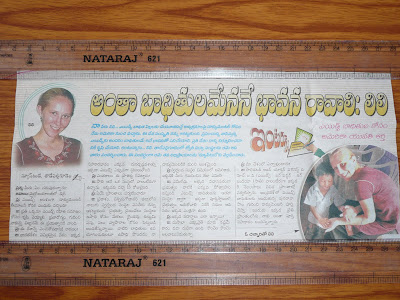
‘We should feel that we are all suffering: Lily’


Monday, October 15, 2007

Making Headlines: Crematoriums, Suffering, etc.

Aka My First Field Visits, October 3-8, 2007

It was just after 8:30 pm when I shouldered my hiking backpack (the one I had been so happy to unpack just two weeks ago), said goodbye to my flat-mates and the prospect of a candle-lit simchat torah dinner, and skipped down the stairs into the end of the rush-hour bustle on Tarnaka-Secunderabad road. After a few tries, I found an auto driver willing to not cheat me, and landed easily on the black marble benches of platform 1, Secunderabad Station. Minutes before our train was set to arrive, my co-worker, M, called, and we pushed (only sort of politely) on to the A/C triple-tier sleeper car. One brief night of fitful rumble-filed sleep later, we stepped down into the warm, slightly wet air of Nellore, the capitol city of the coastal district by the same name. Our hotel was nice, the cable TV stations were even nicer, and we picked up breakfast (idly, of course) at an open-air restaurant on the way to the bus station. The two-hour bus ride to Kavali was occupied by intermittent napping and smiling at a girl about my age taking hundreds of cell phone photos of my white face. [Note: children and women get a smile in return for pointing a camera at me, men get a glare, and I try not to take direct photos of people whom I haven’t met.]

M woke me as the bus driver pulled, apparently arbitrarily, to the side of the road, and as I stumbled down the steps, we were met by two grinning young women – the project coordinator (PC) and the multipurpose health worker (MPHW) who implement my NGO’s OVC program at the grassroots NGO (lets call it NGO-A for this entry) we were about to enter. A small white archway, painted with red lettering and red ribbons, announced the entrance to a compound of three buildings set around a courtyard occupied by a few motorbikes, benches, and a woman setting a baby to rock in a sari cloth draped from a small fruit tree. We were ushered into the main office, and served tea with a side of introductions. We were then promptly ushered back out, and through the care wards. In the first building, the patients stood to meet us, or sat up and spoke from their metal cots stretched across with netting and laid with sheets. They looked weak, a little haunted, but their smiles were broad. In the second building, which M unnecessarily translated for me as the ‘terminal ward,’ the skeletons wrapped in skin, fingers tapping lightly to pass time, chests expanding slightly for attempts at breath, could barely turn their heads. There were no introductions here, and we passed, a small procession of prosperity leaving a grotesque exhibit, quickly back into the sunlight.

While M reviewed the records for our OVC program with the PC and MPHW (in Telugu, of course), I made faces at the children appearing around the edge of the office door. The grinning kids couldn’t speak any more English than the women in the office, but they were happy to communicate by other means. With a ‘it will make them happy’ from M, I stood up to go and play. The little ones disappeared. I peered out of the barred, glassless window. Three faces were peering up, but giggled and dropped down at the sight of my own. Hide and seek had begun. Eventually, after passing through an animalistic snarl-smile game, this turned into a full-on version of Simon Says / do-as-I-do, with a growing audience of older women looking on. We danced. They sang for me. We did somersaults. I touched the ceiling; we waddled on the floor. Eventually, it was time for lunch; meat curries and the special Andhra chutney (leafy greens fried in spices??) with white rice on a banana leaf.

After lunch, we loaded onto an auto and a bike, and took the smooth highway roads out to a tiny town where NGO-A runs an orphanage and school. I asked them later why they had started it. ‘Because,’ the NGO head explained, ‘when we started the care and support center it was one of the first, as part of the state AIDS control program, and people would leave children at our gates in the middle of the night. So we built this to take care of them.’ Practically all of the resources used to build and sustain the orphanage are drawn from the local community – the villagers donated the land, and the labor and materials to build the dormitory and schoolroom. A local TV station did a segment on the home, and decided to donate school uniforms. My NGO provides school supplies, doors, chairs, etc for the classroom. A local businessmen provides enough money to pay two teachers – the NGO head’s wife and brother-in-law work for free as an additional teacher and caretaker.

As we entered the school compound, eighty-odd children, from maybe three to eleven years old, filed out of an open classroom, and sat in a perfect grid, giggling at this strange young woman being offered a nice plastic chair and a cold Limca soda in front of them. After some language-strangled introductions, a talent show began, with individual and group songs, dances and exercises. I taught the first verse and chorus of ‘a great big moose’ (GG4L!) – they made excellent moose antlers, although I’m pretty sure there aren’t any moose in India. They taught me their aerobics routine, and then asked me to lead it. We tried to play elbow tag, but when this seemed to dissolve, they taught me a very different version of hide-and-seek (it involved me being blindfolded with my own dupatta in a large circle of children, trying to track three of them by the sound of their voices). The afternoon wore on, and villagers trickled in, standing quietly at the edge of the playground to watch. After some more official business, and a dash of logistics in translation, we climbed back into the auto to the sound of many ‘good-bye Lili’s (the difference between the vowels in my name are quickly lost in any other language). The buses weren’t coming, so M flagged down a car, and we rode quickly back to the lights, the hotel food, and the Samuel L. Jackson HBO comical-cop movies of downtown Nellore.

With a slightly better night of rest, and a proper set of idly’s behind us, M and I met the PC and MPHW for NGO-B… who had waited breakfast for us, so… after another set of idly’s, and a short car ride to an upper-middle-class neighborhood of Nellore, we left our shoes at the door and went in to meet the director of NGO-B. NGO-B is well established, and provides a wide range of resources; they work in disaster relief and preparation along the coast, in HIV prevention and support services in nearby slums and villages, on income generation projects for the old and disabled, sustaining traditional arts. While M, the PC, and the MPHW leafed through home visit and support group registries, I read the National AIDS Control Office (NACO) policy on Children and AIDS (with a little dozing and a lot of water in the morning heat). For lunch, we were invited to walk a few doors down to the home of the NGO-B head; there was a pile of sweet carrots cooked with mustard seeds, dal made with dark greens (to be dribbled with pure ghee butter), fried greens with chillies, tamarind and white rice, curd to cleanse the palate, fruit, and a strangely green ice cream with raisins and cashews for dessert. We feasted.

After lunch, we traveled to what I thought would be a slum, but was actually an urban clinic in a nice neighborhood. The beds inside were empty, but a woman in a light purple sari occasionally walked in and out of a door marked ‘counselor.’ Left alone, I dozed in a chair. Eventually, women, different ages, draped in different colors, some matching, some wearing tired cloth and tired expressions, trickled in, trailing toddlers in khaki shorts. They sat in a circle on the brilliantly white tiled floor, and when the PC and MPHW joined them there, I sat as well, smiling greetings with enthusiastic head wobbling to try and make up for my complete lack of language. The meeting – a support group for care givers of children infected or affected by HIV – began and soon M joined, asking their permission for me to take photos. I looked at them through the lens, and listened to the cadences of the conversation. Three quarters of an hour passed, and we waved goodbye, trailing schoolchildren’s stares as our car pulled away from the clinic.

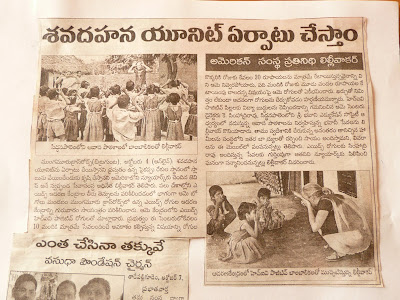
On the way home, M stopped to grab a copy of the district newspaper; a newspaper which contained a strange article about someone named ‘Lily Walker’ who had visited NGO-A the previous day, and promised to build them a crematorium, to provide daily funds for the orphans, and to fix their roof. The photos with the article were clearly of me, although I remain sure in the fact that I barely spoke with the NGO-A head, and mostly just played with the children (providing, of course, such lovely pictures). Back at the NGO, M and I observed a second caregiver’s support group, reviewed more files, talked some more official office talk, looked at photos of programs supported by our NGO, and waved goodbye as the sun was setting. Another night of HBO – John Tucker Must Die – which I justified with our ten-hour site visit days and an intense desire to communicate in fluent English, even if my conversation was with a television screen.

I woke up mentally prepared for one final site visit, and one overnight train home. When we entered the painted metal gates of the large compound of the Sisters’ church and NGO-C, the first things I noticed were the crosses painted on the low wall complemented by a haloed statue of Mary in the center of the driveway. The road leading in was lined with trees being hung with lights for the impending saint’s day feast, and we passed a church and a playground before stopping at the main office. The sisters, Roman Catholic nuns, wore cream colored cotton sari’s, long silver chains laying a cross to rest in the middle of their chests (the silver seems significant in a country where every woman who can even marginally afford to wears gold). The Sisters welcomed us to a dining room, and fed us with tea and sweets and savory chips before ushering us on to an office set aside solely for our OVC program. NGO-C’s main activities center around a home for ‘differently abled’ children; they have a school, vocational training, physical therapy, and a dormitory. The sisters also do outreach work in nearby areas, and it was through this work that they became interested in HIV issues. After the requisite record-reviewing (while I read about access to medicine in India) and expansive lunch-eating – the centerpiece was a special fried fish this time, as sisters eat plain foods – we left the comforting compound for a trip to some nearby villages. Leaving Nellore proper for the neighboring mandal of Kovur, we drove across the top of a damn, an adventure akin to driving through a shallow estuary; however, it seemed to be a main road out.

Our first stop was at a government-funded school run by NGO-C for disabled children. It wasn’t the school children, however, that we were supposed to interact with. A self-help group for HIV infected and affected children was run on the porch, and it was those children, along with a handful of widowed parents and grannies, that we were there to meet. There was an exchange of names, and of songs, and since we did not have time to stay and teach, I sang the refrain from ‘Be Blessed’ (Ebony Singers spring ’07!) in return for a Telugu tune about Jesus’ love.

Back in the car, and past an increasing number of raised ponds ringed with palm trees and small fishing huts, we pulled up an increasingly thin dirt road to the middle of a small but bustling village. Down an ally and around the back of a house we found the meeting – a group of maybe fifty children seated on tarps and facing a row of empty chairs. Assorted mothers and grandmothers sat in the back row, learning against the palm-leaf-roofed houses, pulling the youngest kids in and out of one another’s laps. M, the PC, the MPHW, and I sat down as the panelists, but quickly took a back seat to the usual Music and Dance Revue, which included my rendition of the first verse and chorus of ‘River’ (for those Islanders who care to know). We then embarked on a rousing round of ‘head, shoulders, knees, and toes,’ as they taught me the Telugu word for each body part, and I taught them the motions. The children learned quickly, but an old man in the audience, one whose mind was never quite anchored to this reality, had the biggest and the most glowing grin of them all.

As we waved goodbye, and they clustered together, an elementary school rumble broke out over the opportunity to stand near and wave… and I momentarily felt like the coke bottle in ‘The Gods Must be Crazy.’ Led in the opposite direction from where we’d come, the path back to the car brought us to the front porch of a man living with, and dying from, full-blown AIDS. Handsome, but wasting and match-stick thin, with two grinning, momma-sari-twisting young boys, he spends his days on a cot placed on the porch, partaking as he can in the life passing by along his street. I smiled, unsure of what was expected of me, and M exchanged some sentences I had no hope of following. We left, ponds flashing by as we deserted dirt roads for the highway, and a more direct trip back into town. When we returned to the Sisters’ compound, it was glowing, every fence and tree, every window and eve strung with multi-colored Christmas lights. Over tea and sweets and savories, we recorded our impressions and thanked them for the visit. Their smiles were warm and their genuine enthusiasm palpable as they explained that to gain the people’s trust, they wanted to offer more than information, they wanted to offer services. We smiled, warmly, and left.

Time for dinner, time for shower, time for train. Time to get a phone call from another NGO partner, in another district, begging us to please come to an event the next day in West Godavari. They would pay for everything. Weren’t we already in the field? A business man would be giving one lakh (one hundred thousand) rupees worth of nutritional supplements away to HIV affected children, and having a rep from our NGO at the event would just make the whole day. The volunteer could come too. The possibility of this actually happening fluctuated, so at the moment that I was lying on the top bunk on the train, inches from the air conditioner, pages from finishing ‘God of Small Things,’ and only so many hours of transportation away from my very own bed in my very own apartment, it still came as a surprise, a sort of a mind-game, that M and I would be getting down from the train at Vijayawada sometime between one and two am, and hiring a taxi to drive us two hours through the night (sleeping in the back seat with luggage as a pillow) to Tadepallegudem where we would sleep another two hours in a decently accommodated hotel. But it did actually happen, and after it actually happened, I actually watched most of a modern Lassie movie on television before breakfast had been served and cleared and showers had been taken, and I actually almost cried when Lassie drowned in the river. She probably came running miraculously back over the hill, but that would have been after we had already left.

The approach to the event hosted by NGO-D was not promising. The building looked half-built, and we climbed two flights of newly poured concrete stairs with no right hand wall before emerging onto the second floor, which was rather conspicuously missing the back wall. The room, however unfinished, was packed with over two hundred children, caretakers, NGO staff, and media, with a massive pile of all of their accumulated footwear announcing the crowd at the entrance. I was introduced to a dozen men, none of whose titles I could hear over the garble of giggling, crying, and generally restless children. As the day ripened, and the guests of honor had still not appeared (the guests of honor having clearly no appreciation for the work of the mothers trying to keep their kids relatively still in the massively packed room while nothing in particular happened), some of the braver twelve-year-olds came over to introduce themselves and sit with me. When the guest of honor finally did show up, and I was asked to sit at the front of the room, I continued the smile-sillyface-frown-wink-smile game with the kids in the front row to pass the time as a series of speakers talked about what I presumed was the importance of fighting AIDS and helping children. After speeches (including a rather forced and translated one by yours truly) came handout time, with a massive milling confusion snapped into frames as each child was held by the arm and posed to receive their gift while the donor received a promo photo in return.

I photographed, I handed out, I played hand-clapping games with a little girl in denim and a polo shirt. I smiled blankly at adults, and more sincerely at children. I gave away the AJWS WPF card when I was asked questions above the din. Finally, I ducked away to the office of NGO-D, to a fresh-cooked lunch, and to a journalist waiting for interviews and photos. After my recent bizarre appearance in the Nellore district paper, I wasn’t sure that journalists were a particularly good idea, but decided it might be worth giving my own words a try, with minimized answers about my own life and maximized answers about NGOs, and how ‘we’re all affected by AIDS.’ So there were more photos, more words, more NGO tours. There was waiting and showering and eating under disco-lights. And then there was a bus, with a reclining seat that un-reclined as I slept like a prop in a Charlie Chaplin movie, and that dropped us off twenty kilometers outside of Hyderabad at seven-thirty in the morning because it lacked a permit to enter and security is high these days.

I arrived at work early monday morning, left my luggage behind my desk, brushed my teeth in the office bathroom, and ordered idly for breakfast. A few days later, my office received some news clippings in the mail. ‘We should feel that we are all suffering: Lily.’ ran the headline. The subtitle read, ‘A strong feeling of an American youngster for the victims of AIDS, Interview.’